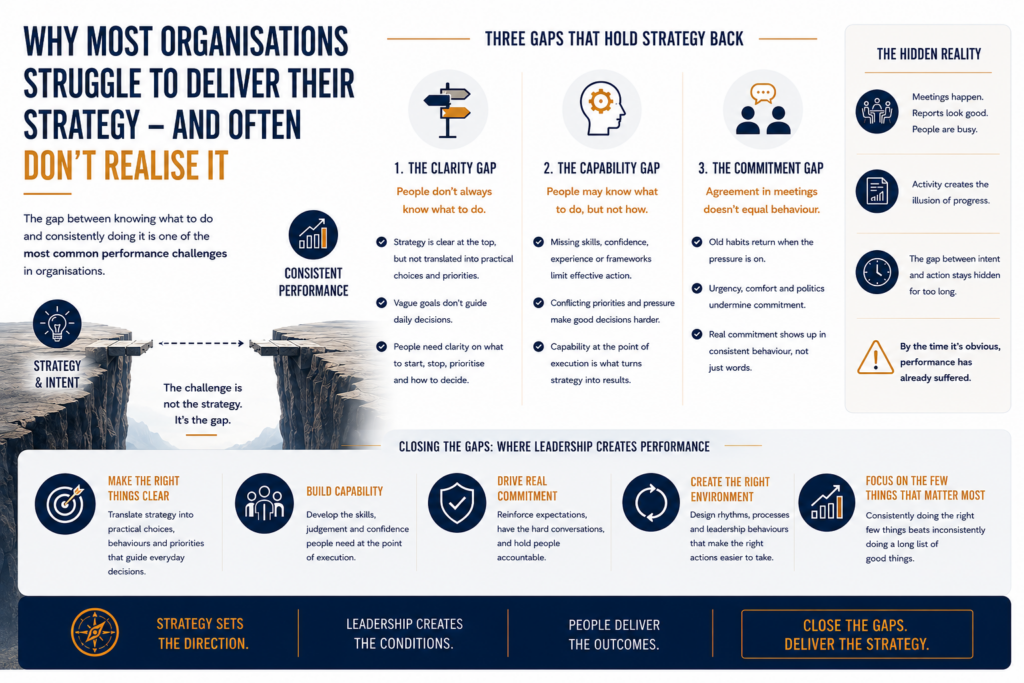
Most organisations know, in a general sense, that they are not performing at their potential. What they typically do not know is where, specifically, the gap is largest – which functions, which processes, which decisions are most limiting overall performance relative to what the organisation is capable of.
This matters because the response to underperformance tends to be broad when it needs to be specific. Organisations launch engagement initiatives, restructuring programmes, and culture change efforts in response to the general sense that something is not working – without the diagnostic precision to identify what specifically needs to change and where the change will have the greatest impact.
We’ve all seen it. A crisis happens. A restructuring occurs. A year later the crisis is back – with a vengeance!!
After two decades of delivering complex programmes across organisations of every size and sector, I have found that underperformance tends to concentrate in predictable places. Identifying these concentrations is the prerequisite for addressing them effectively.
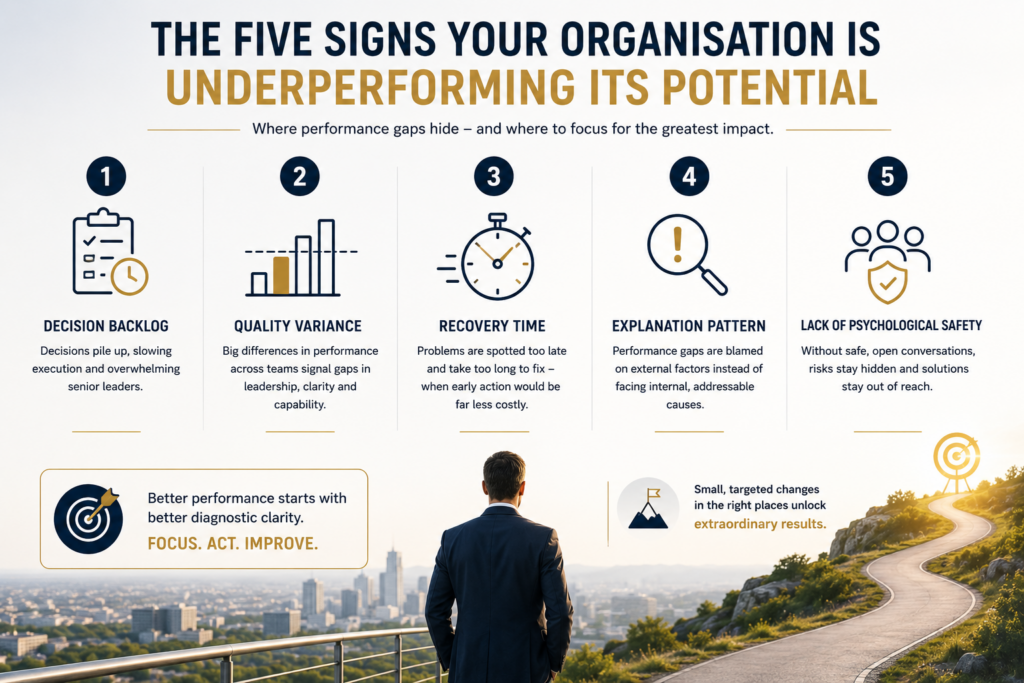
Decision Backlog
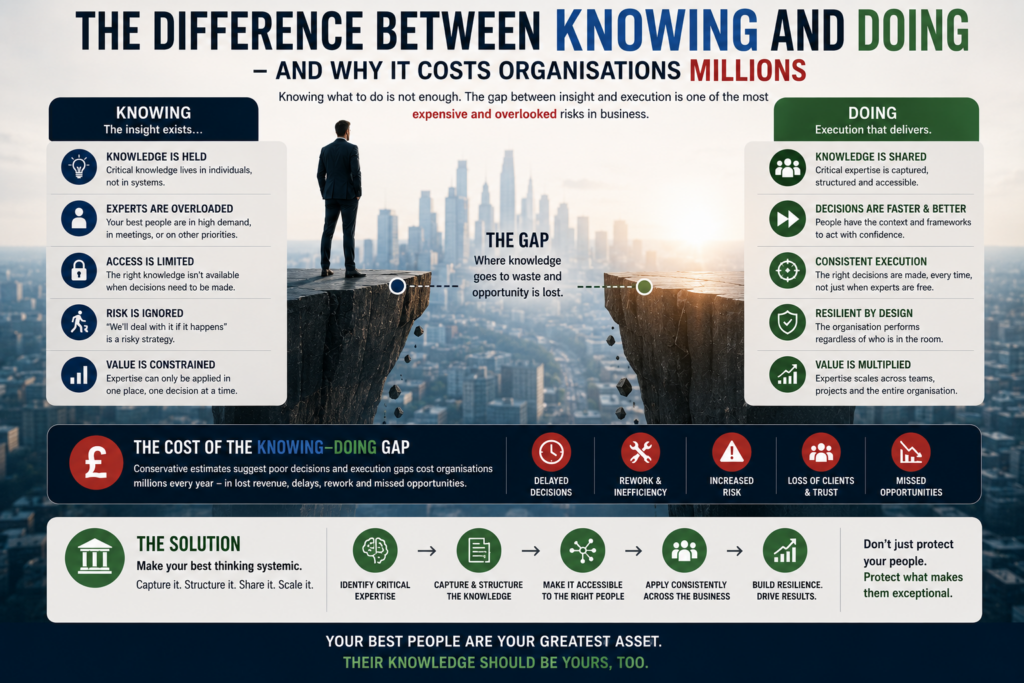
The first sign is the decision backlog. In organisations that are underperforming their potential, decisions accumulate. They are not made, not because the information is unavailable, but because the frameworks, authority, or confidence to make them are absent at the level where they need to be made. The result is a constant flow of decisions upward to people who are already overloaded – and a corresponding slowdown in execution that manifests as missed deadlines, delayed initiatives, and the creeping sense that things are always more difficult than they should be. Senior people, decision makers and sponsors become overloaded.
Quality Variance
The second sign is the quality variance. In high-performing organisations, execution quality is relatively consistent across teams and functions. In underperforming ones, there is significant variance – some teams consistently deliver well, others consistently struggle, and the gap between the best and the worst is large enough that the organisation’s overall performance is substantially lower than expected.
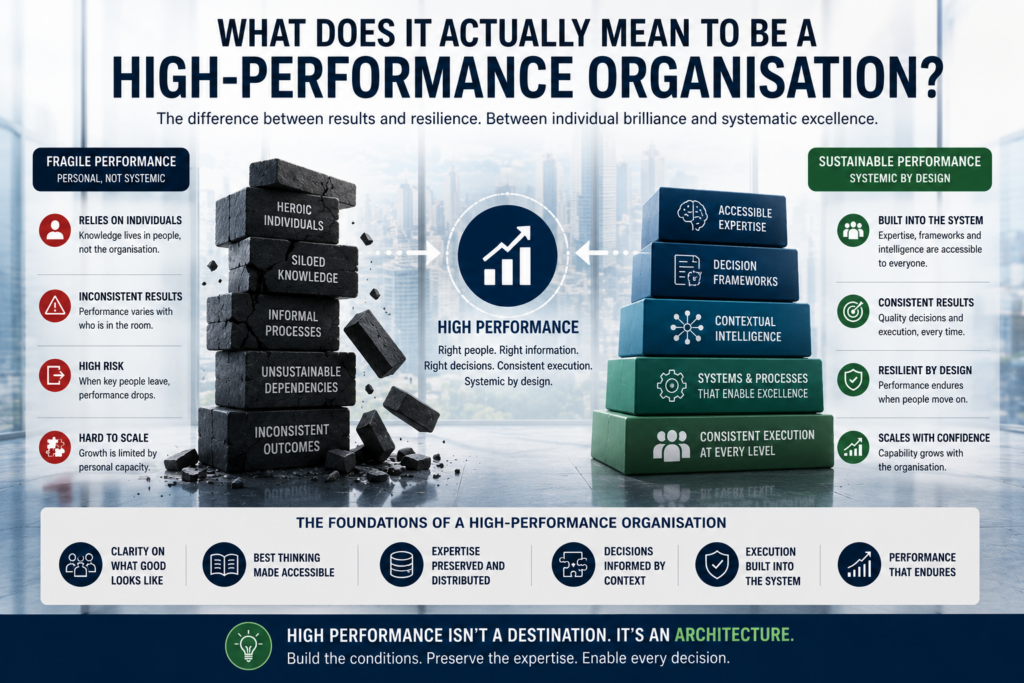
This variance almost always traces back to a small number of factors: the quality of leadership in specific functions, the availability of expertise and decision-making frameworks at the operational level, and the clarity of what good performance looks like in the specific context of each team’s work. Where these factors are strong, performance is strong. Where they are weak, performance is weak. And the gap between the two is typically not as random as it appears – it reflects specific, addressable differences in how those functions are set up and supported.
Recovery Time
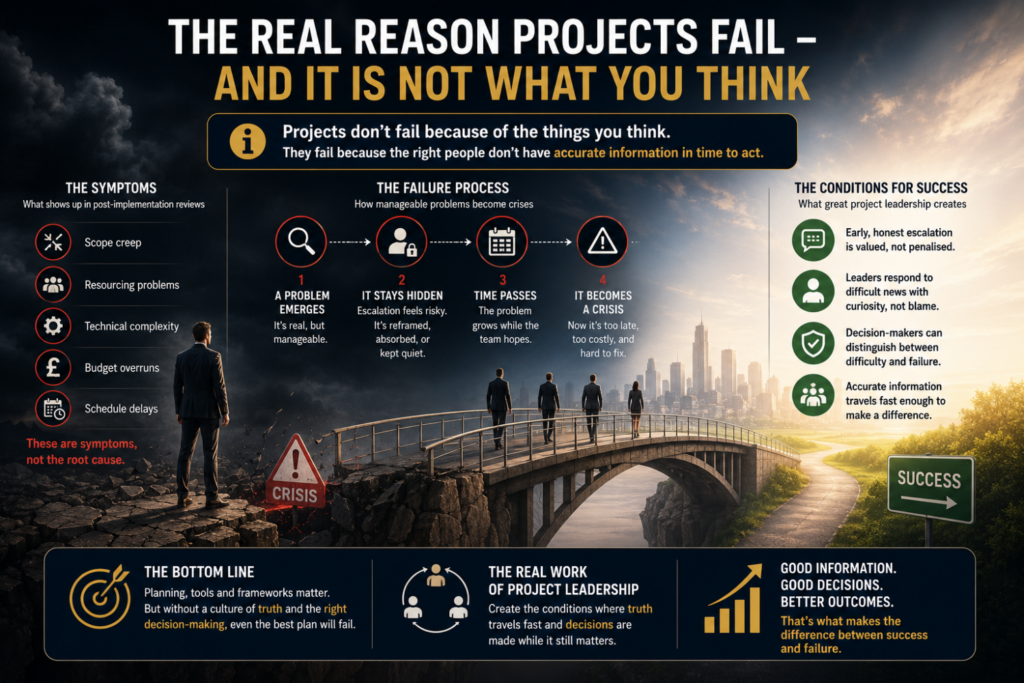
The third sign is the recovery time. Every organisation encounters problems. The difference between those that are performing at their potential or not, is not the frequency of problems but the speed with which they are identified, escalated, and addressed. Organisations with strong execution capability tend to surface problems early and resolve them quickly. Organisations with weaker execution capability tend to surface problems late – often after they have become significantly more costly to address – and resolve them slowly, because the expertise and decision authority needed to act decisively are not readily available at the level where the problem exists. The later in the lifecycle that the actions occur, or the greater the delay, generally, the more costly it is to resolve or eliminate.
Explanations
The fourth sign is the explanation pattern. In underperforming organisations, there is a consistent tendency to explain performance gaps in terms of external factors – market conditions, customer behaviour, competitor activity – rather than in terms of internal capability and decision quality. This is not dishonesty. It is a reflection of what becomes visible when an organisation lacks the diagnostic tools to understand its own performance accurately. External factors are more visible than internal ones. And attributing performance gaps to factors outside the organisation’s control is considerably more comfortable than acknowledging that the gaps are internal and addressable. It is a “blame game” on external forces and the internal team is the innocent “victim”.
Identifying these signs is the starting point. Acting on them requires a different kind of investment from the broad initiatives that most organisations default to – one that is more precise, more specific, and more directly connected to the actual conditions that are limiting performance.
Lack of Psychological Safety
Having a psychologically safe environment, without blame, without persecution is essential to success, and is a commonly found characteristic of many world-leading organisations. Blame, negative emotions and over analysis are short-term responses that detract from the organisational mission. They certainly detract from determining the root cause and eliminating that problem. Team members need to feel safe to voice concerns, articulate risks and propose solutions as quickly as possible.
Organisational intelligence starts with better understanding.
Interested in early platform access or receiving insights on leadership, performance and contextual intelligence – along with updates on the Levare platform.