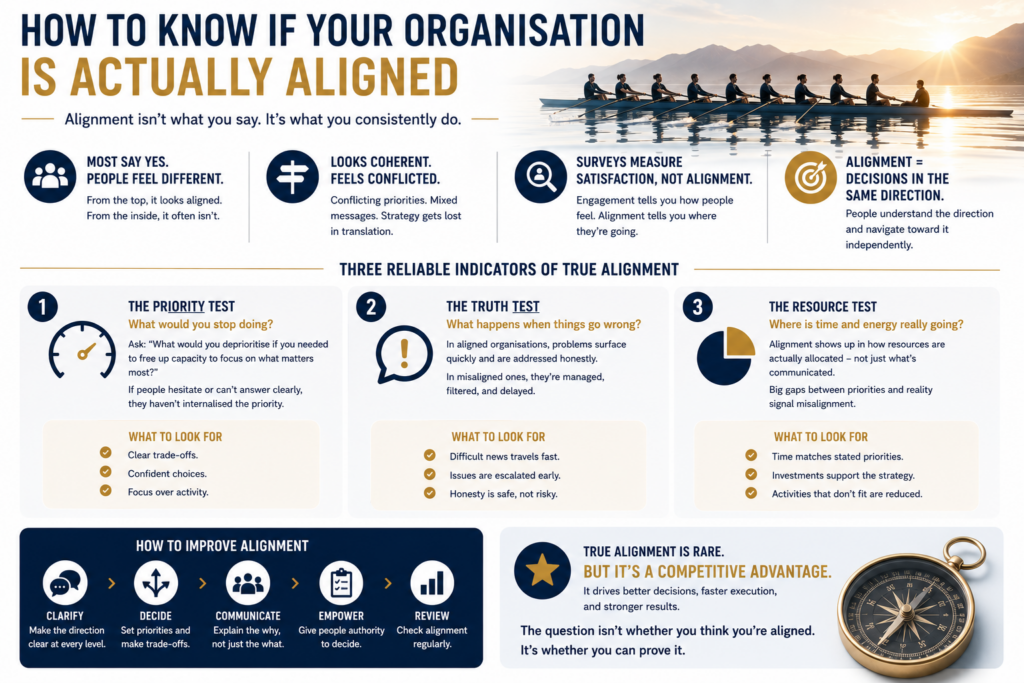
Most organisations will tell you they are aligned. Ask their people, and you will get a different picture.
This is not because leaders are dishonest. It is because alignment is one of the most easily misread conditions in organisational life. From the top, an organisation can look coherent – the strategy is agreed, the leadership team is on the same page, the goals are documented and communicated. From inside, it can feel entirely different. Priorities conflict. Teams pursue objectives that make sense locally but pull against each other at the organisational level. The strategy that was clear in the boardroom becomes ambiguous by the time it reaches the people responsible for executing it.
The result is an organisation that appears aligned and performs as though it is not.
Diagnosing this accurately requires asking better questions than most organisations ask. The standard approach – employee surveys, engagement scores, town halls – tends to measure satisfaction rather than alignment. It tells you whether people feel good about working there, not whether their day-to-day priorities are genuinely consistent with the organisation’s strategic direction.
Alignment is a more specific thing than satisfaction. It is the condition in which the decisions being made at every level of the organisation are consistently pointing in the same direction – not because people have been told to, but because they understand the direction clearly enough to navigate toward it independently.
Testing whether this condition actually exists requires asking questions that most organisations avoid. Not “do you understand our strategy?” – to which most people will say yes regardless of whether they do – but “what would you deprioritise if you needed to free up capacity to focus on what matters most?” The answers to this second question reveal whether people have genuinely internalised the strategic direction or whether they are carrying everything they were already doing with the strategy added on top.
A second indicator of genuine alignment is what happens when things go wrong. In a truly aligned organisation, problems surface quickly and are addressed honestly. The response to a project falling behind is an accurate assessment of what is actually happening and a clear decision about what to do about it. In an organisation that appears aligned but is not, problems tend to be managed rather than addressed – communicated upward in terms that are technically accurate but strategically misleading, filtered through the anxiety of teams who are not sure whether honesty will be well received.
The speed with which accurate information travels upward in an organisation is one of the most reliable indicators of genuine alignment. Not the speed with which good news travels – that is almost universal – but the speed with which difficult, uncertain, or unflattering information makes its way to the people who need to act on it.
A third indicator is resource allocation. In an aligned organisation, where people actually spend their time is consistent with what the organisation says it is prioritising. In most organisations, there is a significant gap between stated priorities and actual resource allocation – a gap that tends to persist because it is uncomfortable to make explicit.
Closing that gap requires a level of organisational honesty that is genuinely difficult to sustain. It means being willing to say, in concrete terms, that time spent on certain activities is not consistent with the organisation’s stated direction – and being willing to change behaviour accordingly.
True alignment is rare. But it is also one of the most powerful competitive advantages an organisation can build. The question is not whether you believe your organisation is aligned. The question is whether you can demonstrate it.
Organisational intelligence starts with better understanding.
Interested in early platform access or receiving insights on leadership, performance and contextual intelligence – along with updates on the Levare platform.