Strategy is one of the most discussed and least precisely understood concepts in business. Every organisation has one. Most leadership teams spend significant time developing and refining it. And yet the outcomes that strategy is supposed to produce – clear direction, consistent decision-making, focused execution – are absent in a surprisingly large proportion of the organisations that invest most heavily in strategic planning.
Having spent twenty-five years working with high-growth technology and services businesses as an executive, investor, and non-executive director, I have observed this disconnect closely and consistently. And I have come to a view about its primary cause that differs from the conventional explanation.
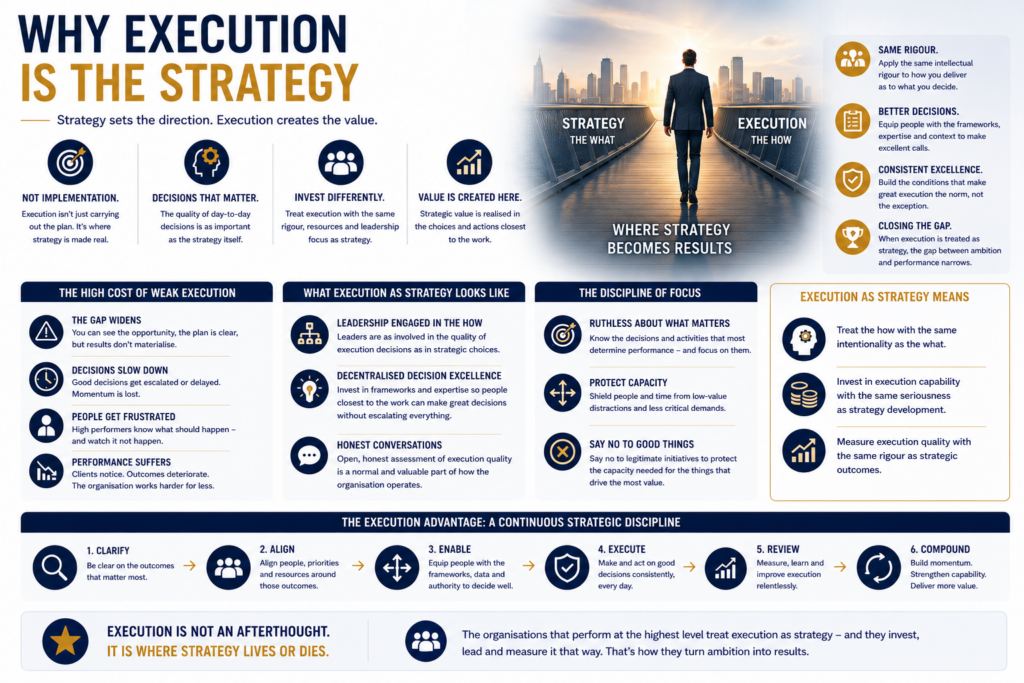
The conventional explanation is that strategy fails because of poor implementation. The strategy itself is sound, but the organisation lacks the capability or the discipline to execute it consistently. This is sometimes true. It is rarely the whole story.
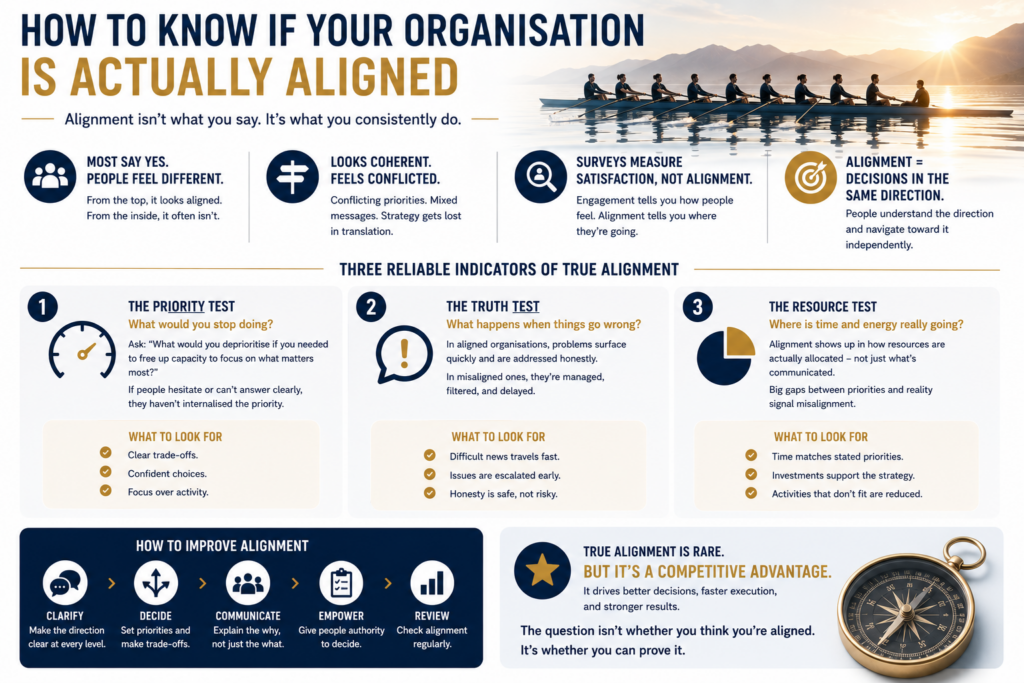
The more fundamental explanation, in most cases, is that the strategy was not as clear as the people who created it believed it to be. It was clear to them – they had spent weeks or months developing the thinking, debating the options, and arriving at conclusions that felt settled. But what was settled in the room where the strategy was created was not transmitted, with equivalent clarity, to the people who needed to act on it.
This is a transmission problem, not an implementation problem. And it requires a different kind of solution.
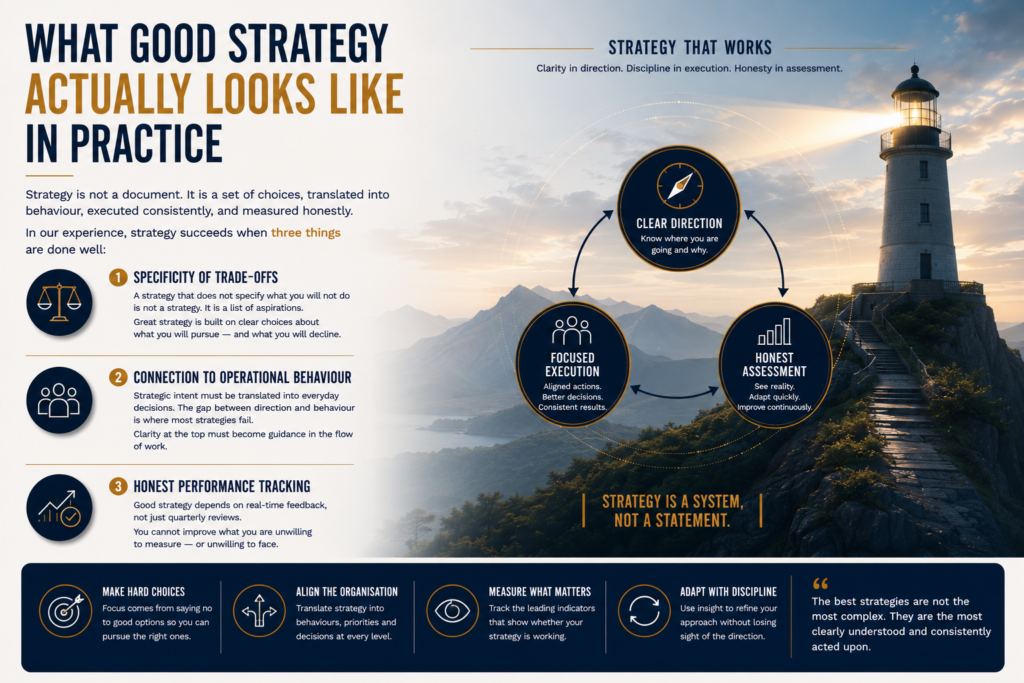
Good strategy in practice has three characteristics that I have observed consistently in the organisations that execute their strategic direction most effectively.
The first is specificity of trade-offs. A strategy that does not specify what the organisation will not do – what it is willing to sacrifice in order to focus on what matters most – is not a strategy. It is a list of aspirations. The hardest and most valuable work in strategic planning is not identifying opportunities. It is making the choices that determine which opportunities the organisation will pursue and which it will decline. These choices, when they are made clearly and communicated honestly, are what give strategic direction its operational bite.
The second is the connection between strategic direction and operational behaviour. The most common failure mode I observe is a strategy that is clear at the level of organisational goals but that has not been translated into specific behavioural guidance for the people responsible for execution. The gap between “we are going to prioritise enterprise clients” and “here is what that means for how you allocate your time, how you qualify opportunities, and how you make decisions when resources are constrained” is enormous. Closing that gap is the work that most strategic planning processes do not do – and that most implementation failures can be traced back to.
The third characteristic is honest performance tracking. Good strategy in practice requires a mechanism for knowing, in real time, whether the direction is being followed and whether it is producing the intended results. This mechanism is more demanding than a quarterly board review. It requires the kind of continuous, honest assessment of the gap between strategic intent and operational reality that most organisations find uncomfortable to sustain – because it invariably surfaces inconvenient truths about where the strategy is working and where it is not.
The organisations that develop all three of these characteristics are the ones that get the most value from their strategic planning investment. They are not necessarily the ones with the best strategies. They are the ones with the most disciplined approach to making their strategies real.
Organisational intelligence starts with better understanding.
Interested in early platform access or receiving insights on leadership, performance and contextual intelligence – along with updates on the Levare platform.