There is a phrase that gets used a lot in discussions about artificial intelligence in business: contextual intelligence. Like many phrases that gain currency quickly, it risks becoming a piece of jargon that means everything in general and nothing in particular.
It is worth being precise about what it actually means – because the concept it describes is genuinely important, and the distinction it draws is one that most organisations have not yet fully grasped.
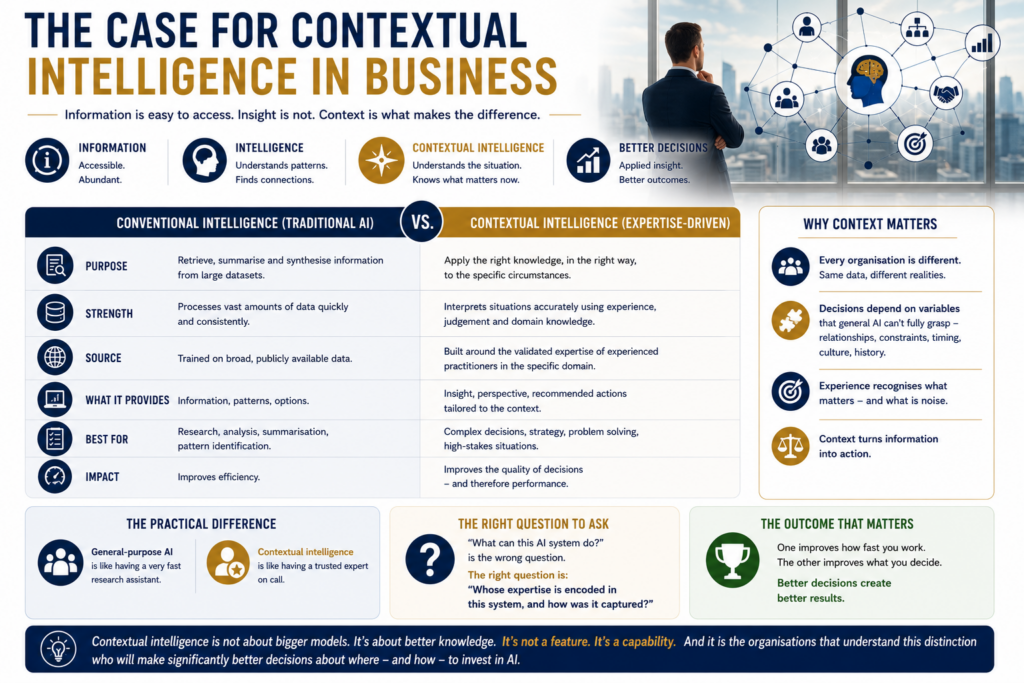
Conventional intelligence – the kind that most AI systems provide – is the ability to retrieve, summarise, and synthesise information from a large dataset. It is extraordinarily useful for certain tasks. If you need to understand what has been written about a topic, identify patterns in a large volume of data, or produce a well-structured summary of a complex situation, conventional AI handles this well and at speed.
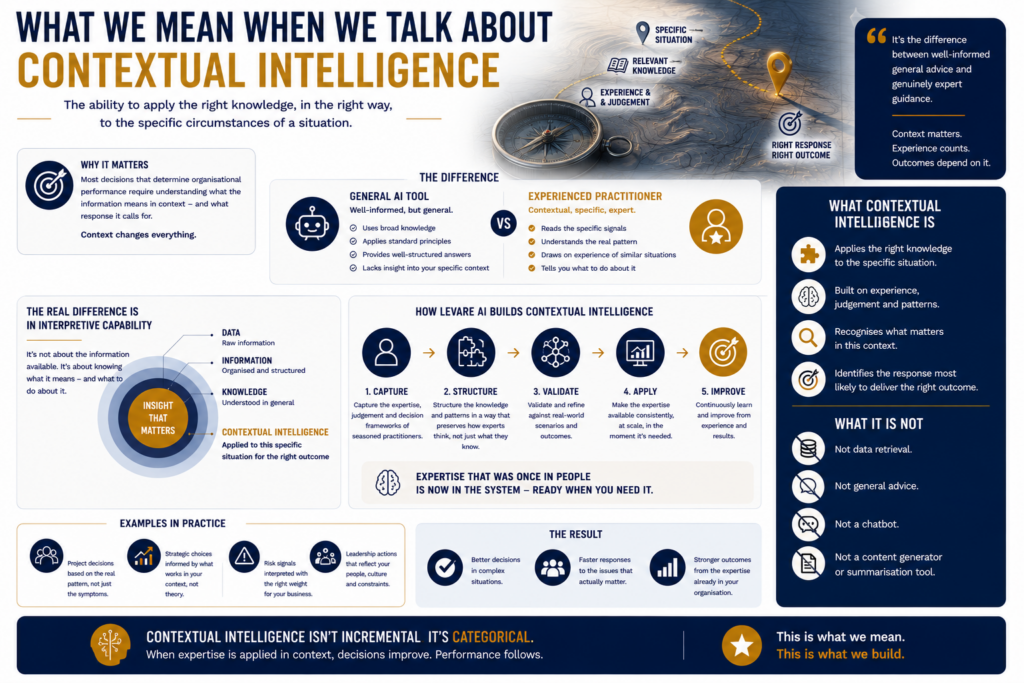
Contextual intelligence is different. It is not about the quantity of information that can be retrieved. It is about the ability to apply the right knowledge, in the right way, to the specific circumstances in front of you.
The distinction matters because the decisions that determine organisational performance are almost never about access to information. They are about interpretation – about being able to read a situation accurately, to understand what the relevant considerations are, and to know how to apply the right response given the specific constraints, relationships, and conditions that exist in this organisation, at this moment, with these people.
This is what experienced practitioners actually do. A seasoned strategy director looking at an organisational challenge does not retrieve information. They interpret a situation using decades of pattern recognition – the accumulated experience of having seen similar situations play out, of understanding what tends to work and what tends to fail, of knowing which variables matter and which are noise.
That kind of intelligence cannot be produced by a general-purpose AI system, no matter how large the model or how extensive the training data. It can only come from a system that has been built around the specific expertise of people who have genuinely operated at the highest levels in the relevant domain.
This is what distinguishes contextual intelligence from conventional AI. Not the sophistication of the underlying technology, but the quality and specificity of the expertise that the system encodes.
The practical implications of this distinction are significant. An organisation that deploys a general-purpose AI tool is getting a capable information retrieval system. An organisation that deploys contextual intelligence – built around genuine domain expertise – is getting something closer to having a recognised expert available on demand, one whose knowledge has been structured and made accessible in the specific situations where it is most needed.
The difference in outcomes between these two approaches is not incremental. It is categorical. One improves efficiency. The other improves the quality of decisions – and the quality of decisions is what determines performance.
Understanding this distinction is important for any organisation that is evaluating how to invest in AI. The question to ask is not “what can this AI system do?” It is “whose expertise is encoded in this system, and how was that expertise captured?”
If the answer is “it was trained on a large dataset of publicly available information,” that tells you what kind of intelligence you are getting. If the answer is “it was built around the validated knowledge of practitioners who have spent decades in this specific domain,” that tells you something very different.
Contextual intelligence is not a marketing term. It is a specific capability – and the organisations that understand the distinction will make significantly better decisions about where to deploy it.
Organisational intelligence starts with better understanding.
Interested in early platform access or receiving insights on leadership, performance and contextual intelligence – along with updates on the Levare platform.