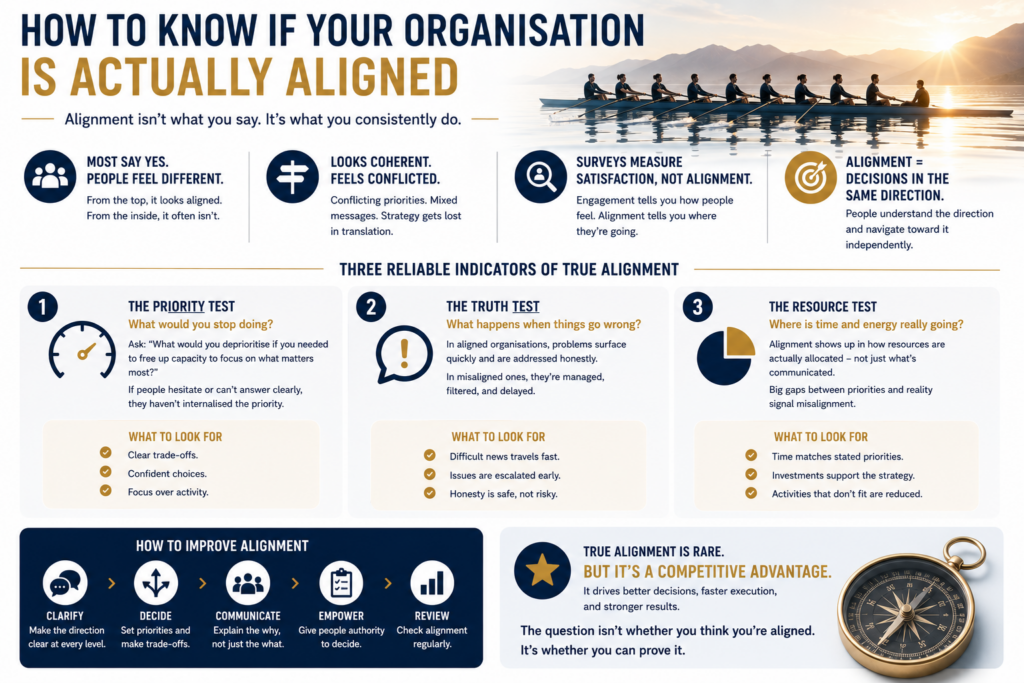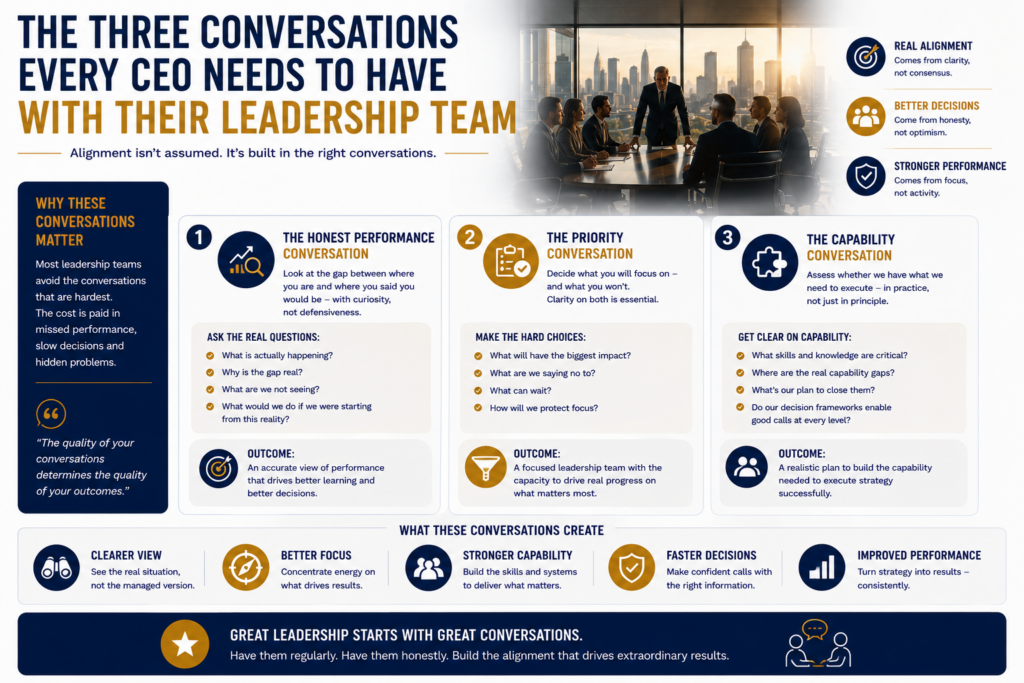
There are three conversations that determine whether a leadership team is genuinely aligned or merely appears to be. Most organisations have none of them consistently. The ones that do tend to perform significantly better than those that do not.
The first is the honest performance conversation. Not the performance review, and not the board presentation – both of which tend to be shaped by the incentives that surround them. The honest performance conversation is the one in which a leadership team looks at the gap between where the organisation is and where it said it would be, and examines that gap with genuine curiosity rather than defensive explanation.
In most organisations, the narrative around performance is managed. Underperformance is contextualised. Targets that were not met are reframed as progress. The external factors that contributed to disappointing results are emphasised. This is understandable – leadership teams are human, and the instinct to protect oneself and one’s team from uncomfortable assessments is natural.
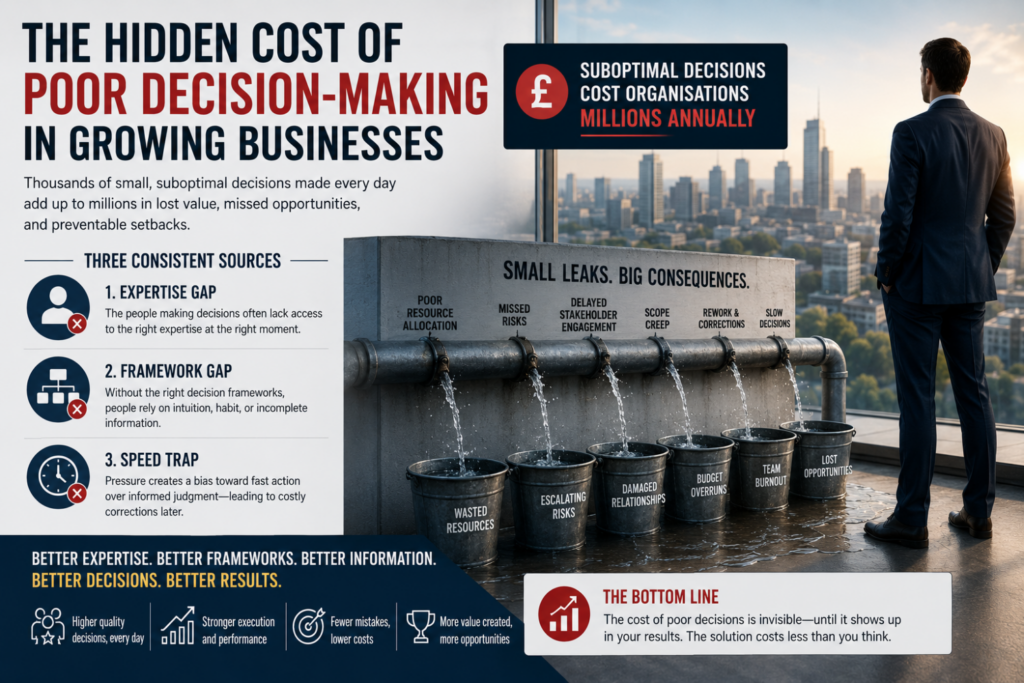
But organisations that manage the narrative around performance rather than confronting it directly pay a significant cost. They lose the ability to learn from what is actually happening. They make decisions based on a picture of performance that is more favourable than reality. And they tend to be slower to address problems that, if caught earlier, would have been considerably easier to fix.
The honest performance conversation is the one that asks: what is actually happening here, and why? Not to apportion blame, but to develop an accurate understanding of the organisation’s real position.
The second conversation is the priority conversation. Most leadership teams have more priorities than they have capacity to address effectively. This is not unusual – the demands on any growing organisation typically outpace its resources. What distinguishes high-performing leadership teams is not that they have fewer demands, but that they are more disciplined about which ones they actually commit to.
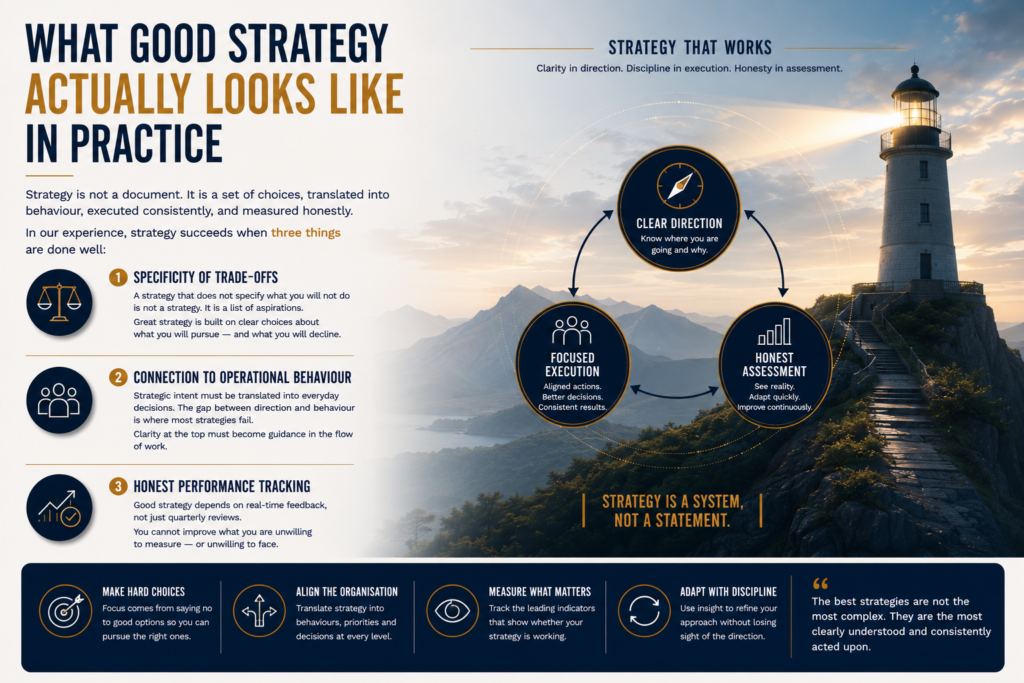
The priority conversation is the one in which a leadership team explicitly names what it is going to focus on – and, equally importantly, what it is not. This second part is where most leadership teams struggle. Deprioritising feels like abandoning. Saying no to a legitimate initiative feels uncomfortable when the case for it is real. And so most organisations end up with a list of priorities that is too long to execute well, and a leadership team that is stretched across too many fronts to drive decisive progress on any of them.
The discipline of the priority conversation is the discipline of choosing. Not “we will do all of these eventually” but “these are the three things we are actually going to drive this quarter, and everything else will wait.” This is harder than it sounds, and it requires a level of strategic maturity that many leadership teams are still developing.
The third conversation is the capability conversation. This is the conversation about whether the organisation has what it actually needs to execute on its commitments – not in principle, but in practice. Do the people who need to deliver the strategy have the skills, the knowledge, and the decision-making frameworks to do so? Where are the genuine capability gaps? And what is the realistic plan to close them?
This conversation is avoided in most organisations because it is uncomfortable. Acknowledging capability gaps feels like criticising people. And leadership teams are often reluctant to make explicit the distance between the organisation’s current capability and what the strategy actually requires.
But the cost of avoiding it is high. Strategies that are not executed because the capability to execute them was not in place are not failed strategies. They are strategies that were never genuinely tested. And the organisations that have the discipline to have the capability conversation honestly are the ones that build realistic plans rather than optimistic ones – and deliver on them more consistently as a result.
Organisational intelligence starts with better understanding.
Interested in early platform access or receiving insights on leadership, performance and contextual intelligence – along with updates on the Levare platform.