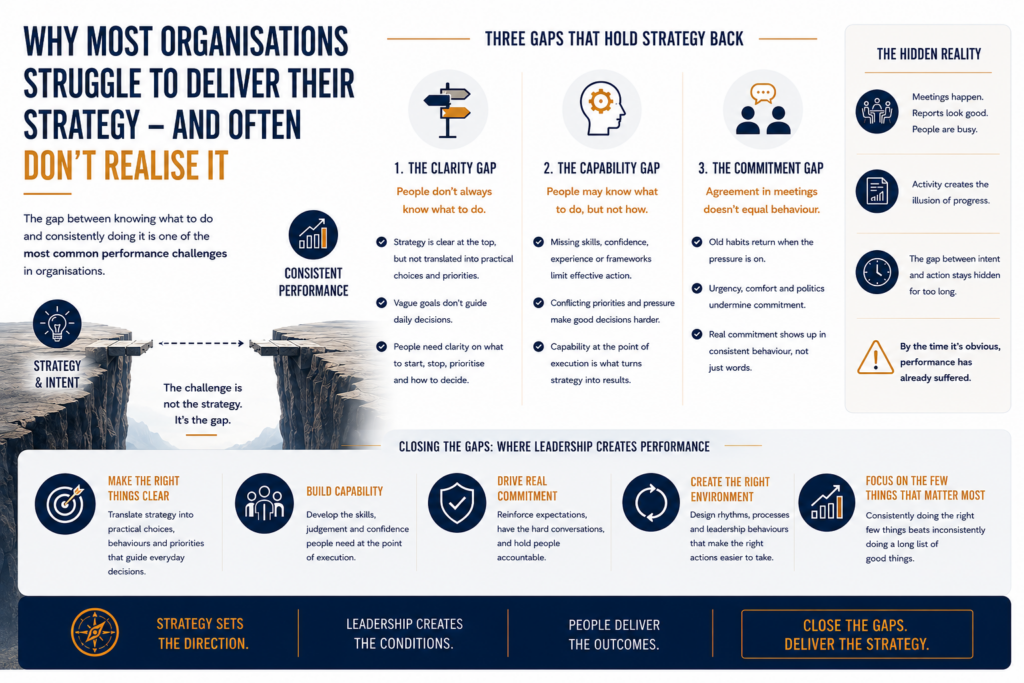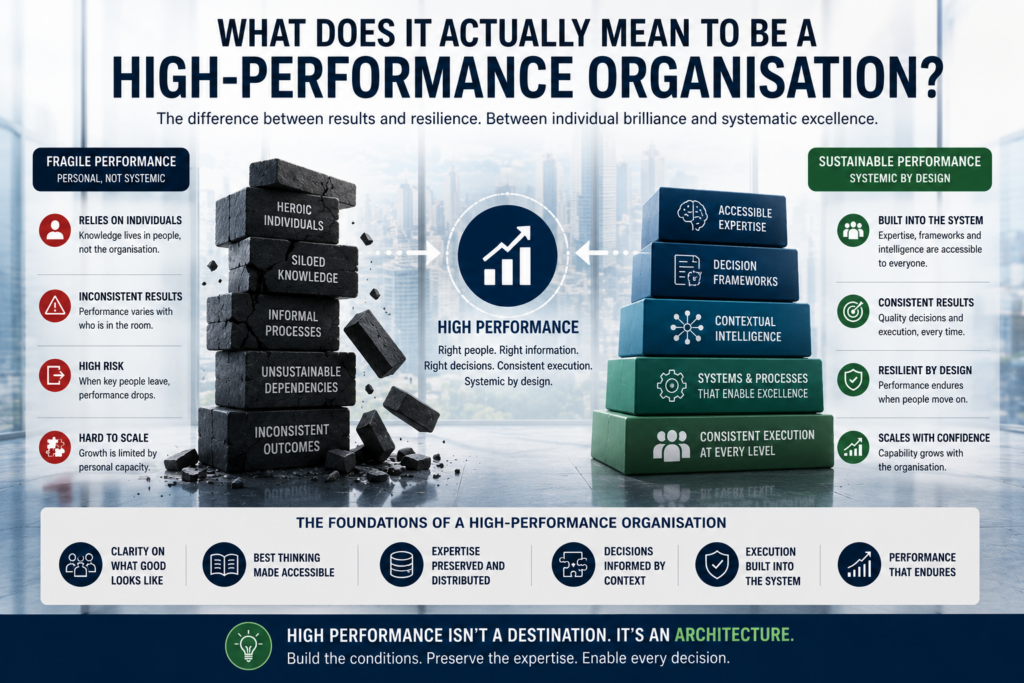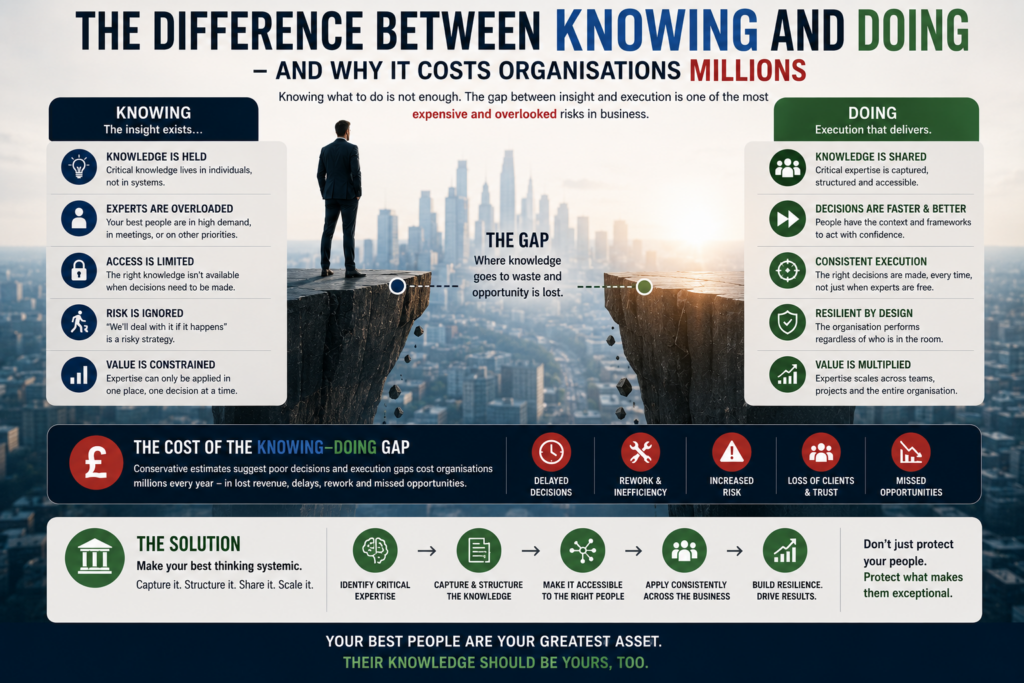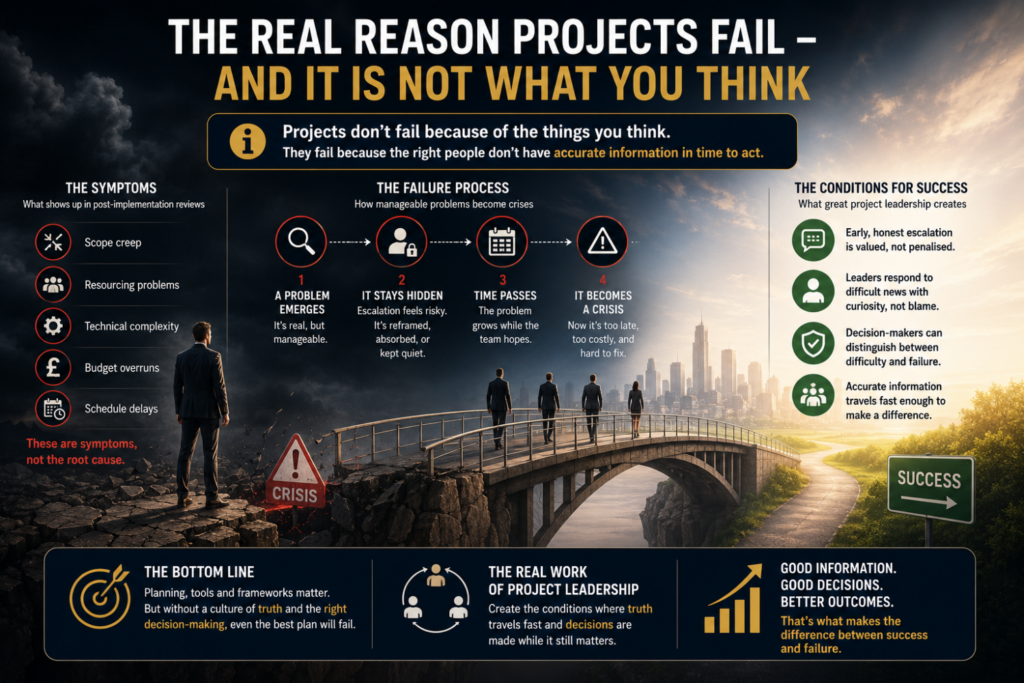
What does good actually look like in organisational execution? This question is asked less often than it should be, given how much time and resource organisations invest in trying to improve their performance.
The reason it is asked infrequently is that the answer is uncomfortable. Defining good precisely enough to be genuinely useful requires being explicit about where the organisation currently falls short of it. And explicit acknowledgment of the gap between current performance and good performance is something that most leadership teams find difficult to sustain in the face of the natural pressure to protect and promote the organisation’s narrative.
I want to try to answer the question precisely, drawing on two decades of working with organisations on execution and performance.
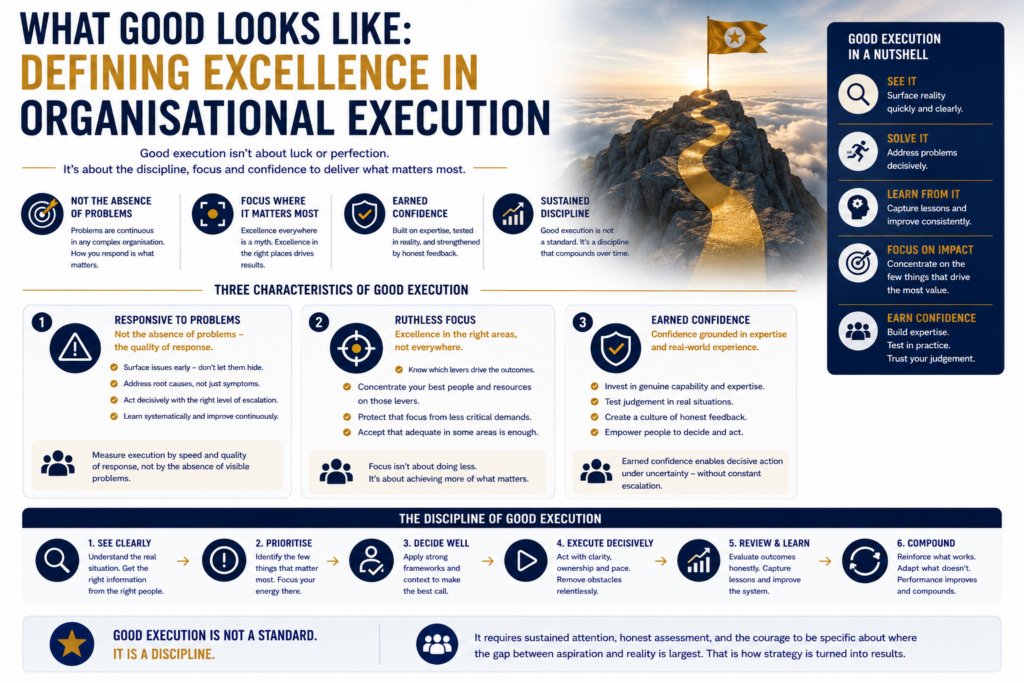
Good execution is not the absence of problems. In any organisation of meaningful complexity, problems are continuous – not a sign of failure but a sign of operation. The organisations that execute well are not those that avoid problems. They are those that surface them quickly, address them decisively, and learn from them systematically.
This distinction has important practical implications. An organisation that measures its execution quality by the absence of visible problems will create the conditions for problems to be hidden rather than addressed – because the incentive structure rewards the management of appearances rather than the management of reality. An organisation that measures its execution quality by the speed and quality of its response to problems creates the opposite incentive structure, and gets dramatically better information about where it actually is.
Good execution is also not uniformly high performance across every dimension. Every organisation has finite resource and finite attention. The organisations that execute most effectively are those that have made the most honest assessment of which dimensions of performance most determine their overall outcomes – and that have concentrated their best people, their best processes, and their best decision-making frameworks in those dimensions, accepting that performance in less critical areas will be adequate rather than excellent.
This kind of deliberate focus is harder to achieve than it sounds, because it requires resisting the pressure to be excellent at everything. Most organisations are under pressure from multiple directions simultaneously – from clients, from competition, from internal stakeholders, from their own ambitious standards. The default response to this pressure is to try to improve everything. The more effective response is to be very clear about what matters most and to ensure that the focus, resource, and expertise required to be genuinely excellent in those areas is consistently available.
The third characteristic of good execution is what I call earned confidence – the condition in which the people responsible for delivering outcomes are confident in their own judgement because that judgement is grounded in genuine expertise and has been tested against real situations. This is different from the kind of confidence that comes from optimism or from a culture that discourages the honest acknowledgment of uncertainty.
Earned confidence allows organisations to move decisively under conditions of uncertainty – which is the condition under which most important decisions are actually made. It allows leaders at the operational level to make calls without constant escalation, because they trust their own frameworks and know that the organisation has the resilience to absorb the occasional mistake made in good faith.
Building earned confidence requires investment in genuine expertise development, honest feedback, and the kind of leadership that responds to honest acknowledgment of uncertainty with support rather than anxiety. It is not a quick or easy investment. But it is one of the most durable competitive advantages an organisation can build.
Good execution is not a standard. It is a discipline – one that requires sustained attention, honest assessment, and the courage to be specific about where the gap between aspiration and reality is largest.
Organisational intelligence starts with better understanding.
Interested in early platform access or receiving insights on leadership, performance and contextual intelligence – along with updates on the Levare platform.