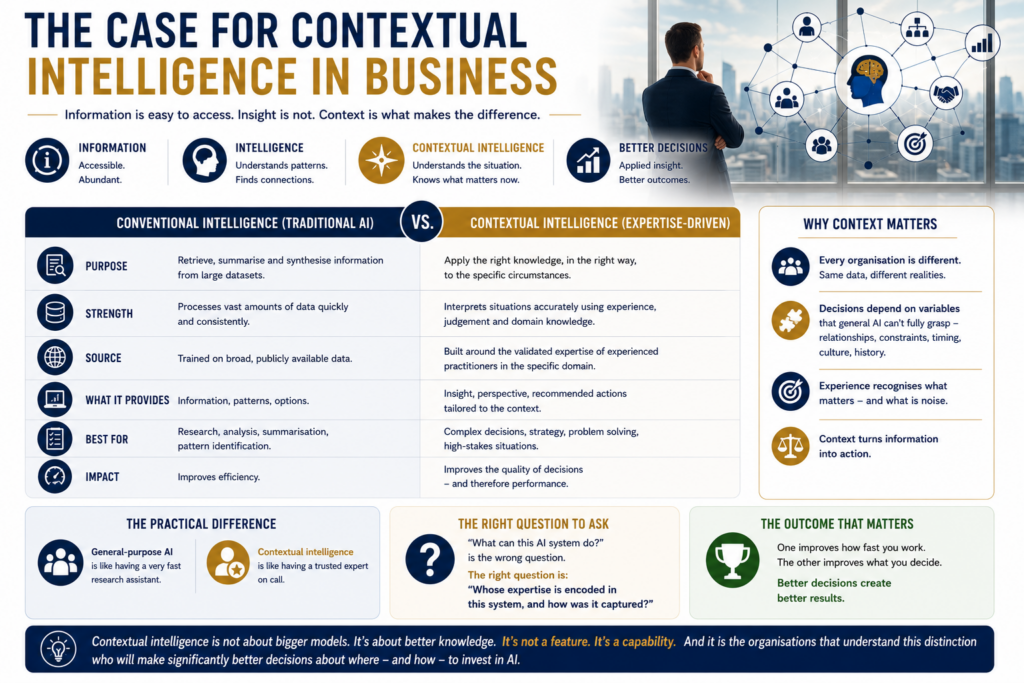
Contextual intelligence is a term that risks becoming a piece of business jargon – adopted widely, defined loosely, and used in ways that obscure rather than illuminate what it actually means.
At Levare AI, we use it in a specific and precise sense. Understanding exactly what we mean by it – and what we do not mean – matters for anyone evaluating whether it is something their organisation needs.
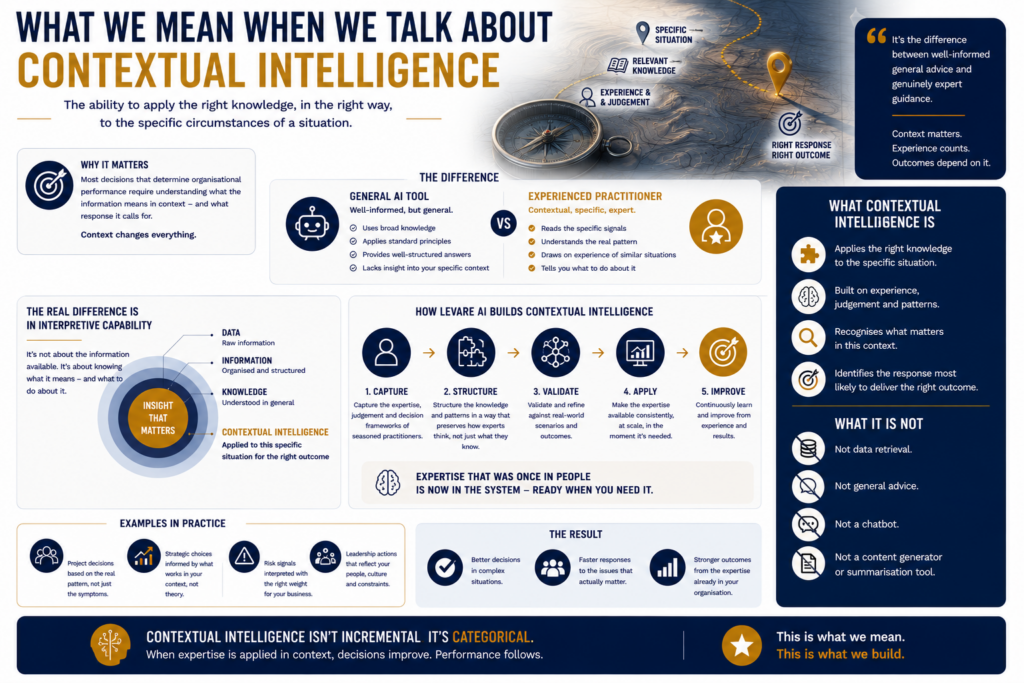
Contextual intelligence is the ability to apply the right knowledge, in the right way, to the specific circumstances of a situation. It is the quality that distinguishes genuinely expert guidance from well-informed general advice.
Consider the difference between asking a general AI tool whether a project is on track and asking an experienced programme director who has delivered a hundred complex implementations. The general AI tool will give you a well-structured response based on standard project management principles. The experienced director will read the specific signals you describe – the nature of the delays, the pattern of the risks, the behaviour of the team – and tell you, based on having seen this pattern before, what is actually happening and what you need to do about it.
The difference is not in the information available to each. It is in the interpretive capability – the ability to know what the information means in context and what response it calls for.
This is what contextual intelligence is. Not data retrieval. Not general advice. The application of structured, experience-based expertise to the specific situation in front of you.
The reason this distinction matters practically is that most of the decisions that determine organisational performance require contextual intelligence rather than general information. They are not questions that can be answered by retrieving what has been written about the topic. They are questions that require the ability to read a specific situation accurately, to understand what the relevant considerations are given the specific constraints and conditions that apply, and to identify the response most likely to produce the right outcome in this organisation, at this moment, with these people.
General-purpose AI systems are not designed to provide this. They are designed to be useful across a very wide range of topics, which means they are optimised for breadth rather than depth. They can summarise what has been written about organisational alignment, but they cannot tell you whether your specific organisation is aligned or what the most important thing to do about it is.
Contextual intelligence, as we build it at Levare AI, starts in a different place. It starts with the expertise itself – with the knowledge, judgement, and decision frameworks of practitioners who have spent decades in a specific domain. It captures not just what they know, but how they think – the specific patterns they have learned to recognise, the signals they have learned to weight, the responses they have learned to apply in specific circumstances.
That expertise is then structured into a form that can be applied consistently and at scale – available to the organisations that need it, at the moment they need it, without requiring the physical presence of the practitioner who holds it.
This is contextual intelligence. Not AI in the generic sense. Not a chatbot or a content generator or a summarisation tool. Intelligence that is specific, validated, and built to improve the quality of the decisions that actually determine whether an organisation performs at its potential.
When we talk about contextual intelligence, this is precisely what we mean. And the difference between this and what most AI tools provide is not incremental. It is categorical.
Organisational intelligence starts with better understanding.
Interested in early platform access or receiving insights on leadership, performance and contextual intelligence – along with updates on the Levare platform.