Digital transformation has been one of the most consistently overpromised and underdelivered categories in business management for the past two decades. The investments have been substantial. The results, in aggregate, have been considerably more modest than the business cases suggested they would be.
Understanding why requires being honest about a fundamental mismatch that has characterised most digital transformation programmes from the outset.
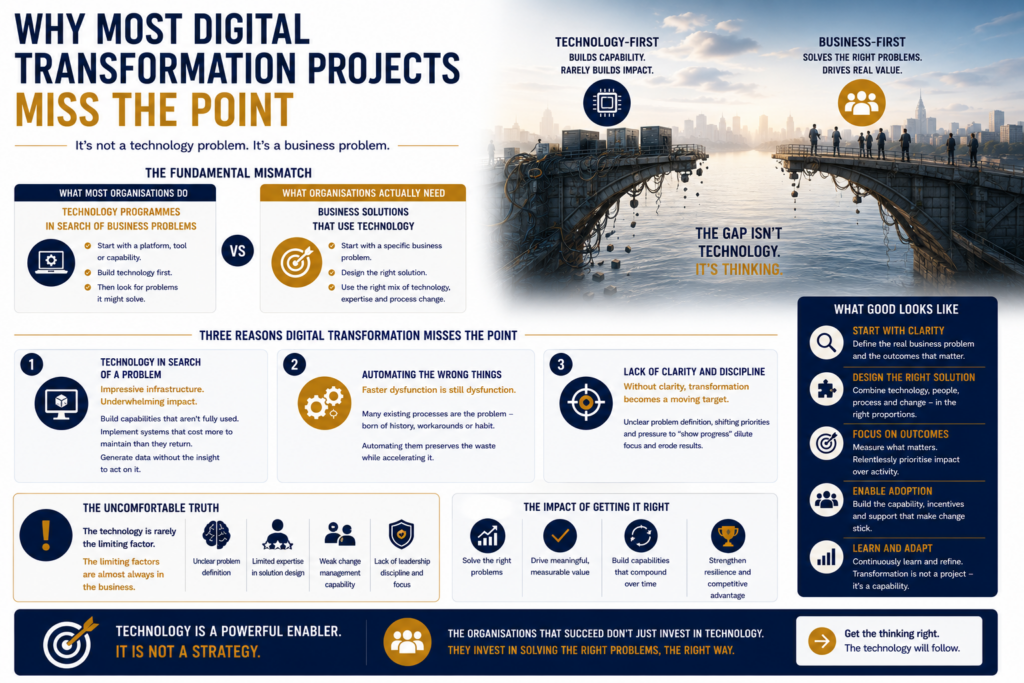
The mismatch is this: most digital transformation efforts have been technology programmes in search of business problems, when what organisations actually needed were business solutions that happened to use technology.
This distinction matters because it determines everything about how the programme is designed, where the investment goes, and what success looks like. A technology programme starts with a platform, a tool, or a set of capabilities and asks what the organisation can do with them. A business solution starts with a specific problem – a decision that is being made badly, a process that is creating unnecessary friction, a capability that the organisation needs but does not have – and asks what combination of technology, expertise, and process change will address it.
The technology-first approach has produced a generation of digital transformation programmes characterised by impressive infrastructure, sophisticated platforms, and underwhelming business impact. Organisations have built capabilities they do not fully use, implemented systems that require more effort to maintain than the efficiency they return, and generated data that nobody has the interpretive capability to convert into useful intelligence.
The second reason digital transformation programmes miss the point is closely related. They tend to focus on automating existing processes rather than asking whether those processes are worth automating.
Process automation has genuine value when the process being automated is itself a good one – when it is designed correctly, produces the right outcomes, and would benefit from being executed faster and more consistently. But many of the processes that organisations seek to automate are themselves the problem. They exist because of historical constraints, organisational habits, or the accumulated workarounds of previous technology implementations. Automating them makes them faster and more consistent while preserving the underlying dysfunction.
The organisations that have gotten the most genuine value from digital investment are those that started with an honest assessment of what was actually limiting their performance, identified where technology could address those specific limitations, and built their programmes around that clarity rather than around the capabilities of a chosen platform.
This requires a different kind of leadership capability from what most digital transformation programmes develop. It requires leaders who can think precisely about business problems, who can distinguish between problems that technology can address and problems that require other kinds of intervention, and who can maintain strategic discipline in the face of the significant organisational pressure that tends to build around large technology programmes.
The uncomfortable truth about digital transformation is that the technology is rarely the limiting factor. The limiting factors are almost always in the business – in the clarity of problem definition, in the quality of expertise applied to solution design, in the change management capability available to support adoption, and in the leadership discipline to keep the programme focused on outcomes rather than outputs.
Technology is a powerful enabler. It is not a strategy. And confusing the two is the most consistent reason that digital transformation programmes miss the point.
Organisational intelligence starts with better understanding.
Interested in early platform access or receiving insights on leadership, performance and contextual intelligence – along with updates on the Levare platform.