Resilience is one of those organisational qualities that everybody claims to value and almost nobody builds systematically.
It tends to be discussed in one of two contexts: after a crisis, when it becomes obvious that the organisation was not as resilient as it believed itself to be, or in the abstract, as an aspirational quality that organisations say they want without being specific about what building it actually requires.
I want to be specific. After two decades of working with organisations on complex, mission-critical programmes – including programmes where the consequences of failure were immediately operational rather than merely financial – I have developed a clear view of what genuine organisational resilience looks like and what it takes to build it.
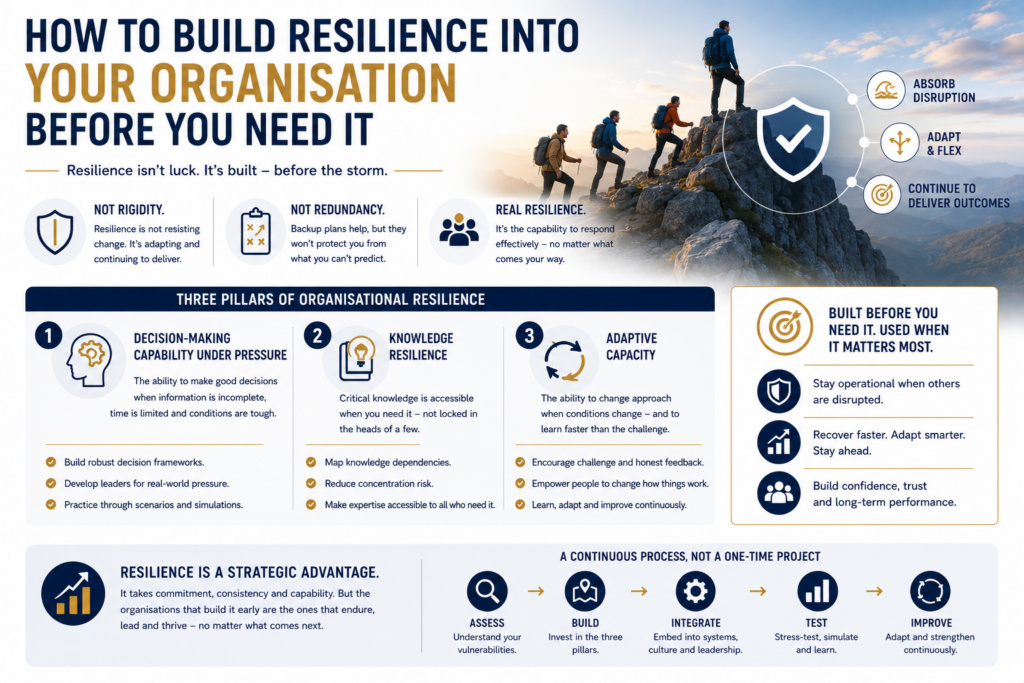
Genuine resilience is not the ability to absorb disruption without changing. That is rigidity, not resilience, and it tends to be brittle rather than robust. Genuine resilience is the ability to absorb disruption, to flex and adapt and to continue to deliver critical outcomes – not necessarily in the same way, but effectively.
The difference between these two things matters greatly, because building them requires different investments. Organisations that confuse rigidity with resilience tend to invest in redundancy – in backup systems, in duplicate processes, in the kind of belt-and-braces “quality control” processes and infrastructure that protects against the specific failures they have imagined while leaving them exposed to the failures they have not.
Organisations that build genuine resilience invest in something different: the capability to respond effectively to disruption regardless of its specific form. This requires, above all, three things.
Capability Under Pressure
The first is decision-making capability under pressure. Resilient organisations can make good decisions when conditions are degraded – when information is incomplete, when time is limited, and when the normal structures and processes that support decision-making are themselves disrupted. This capability does not emerge spontaneously. It is built through deliberate practice, through the development of decision frameworks that are robust enough to apply under pressure, and through the kind of leadership development that prepares people for the decisions they will actually face rather than the decisions that look best on a competency framework.
Knowledge Resilience
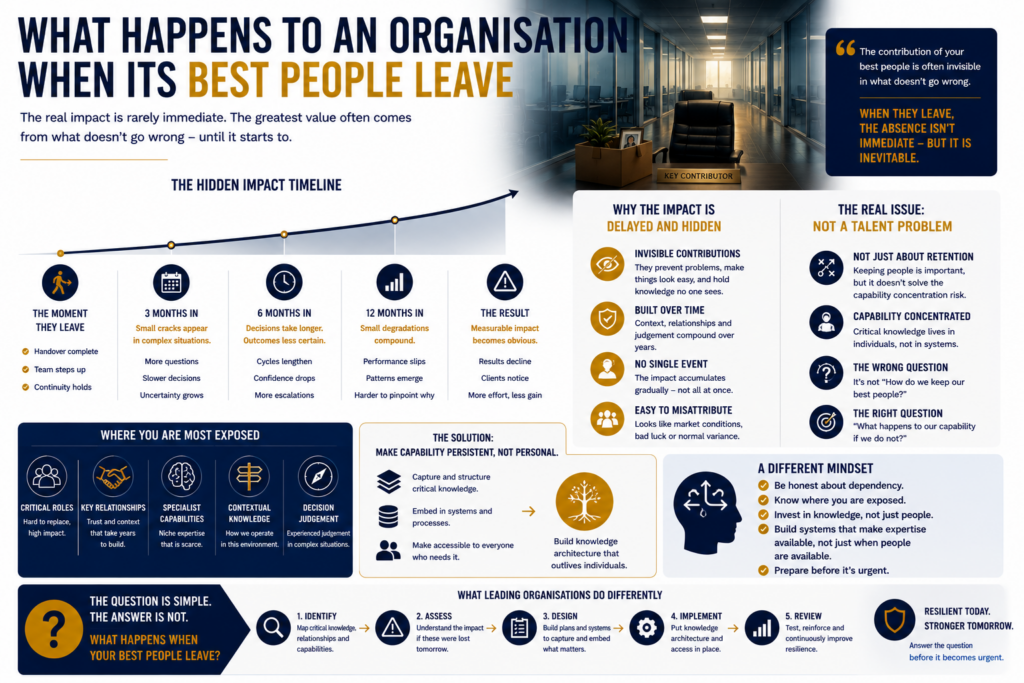
The second is knowledge resilience. Resilient organisations have ensured that their critical knowledge is not concentrated in individuals to a degree that creates unacceptable exposure. They have mapped their knowledge dependencies, identified their most significant concentrations, and found mechanisms to make critical expertise accessible even when the individuals who hold it are not available.
This is one of the most consistently underdeveloped dimensions of organisational resilience. The focus tends to be on process resilience – on documented procedures, on backup systems, on recovery plans – while the knowledge resilience question – do we have access to the expertise we need to make good decisions under pressure – receives significantly less attention.
Adaptive Capacity
The third is adaptive capacity – the ability to change how things are done in response to conditions that were not anticipated. This is perhaps the hardest of the three to build deliberately, because it depends on a quality of organisational culture that cannot be mandated or process-engineered: the willingness to depart from established patterns when those patterns are not working, rather than persisting with them because they are familiar.
Organisations with strong adaptive capacity tend to have cultures where learning from experience is genuinely valued, where the honest assessment of what is not working is welcomed rather than suppressed, and where the authority to change approach in response to evidence is genuinely distributed rather than concentrated at the top.
Building genuine resilience requires investment in all three of these dimensions – simultaneously and sustainably. It is not a crisis response programme. It is a standing commitment to maintaining the capability to deliver even when conditions are not favourable.
Having delivered this across multiple organisations, through repeatable processes, then driving consistency then backing up those quantitative data to provide support or expose deficiencies, the organisations that make this commitment before they need it are the ones that find it most useful when they do need it.
Organisational intelligence starts with better understanding.
Interested in early platform access or receiving insights on leadership, performance and contextual intelligence – along with updates on the Levare platform.