Digital twins are no longer a futuristic idea. In engineering, manufacturing and operational environments, they are already being used in serious and commercially valuable ways.
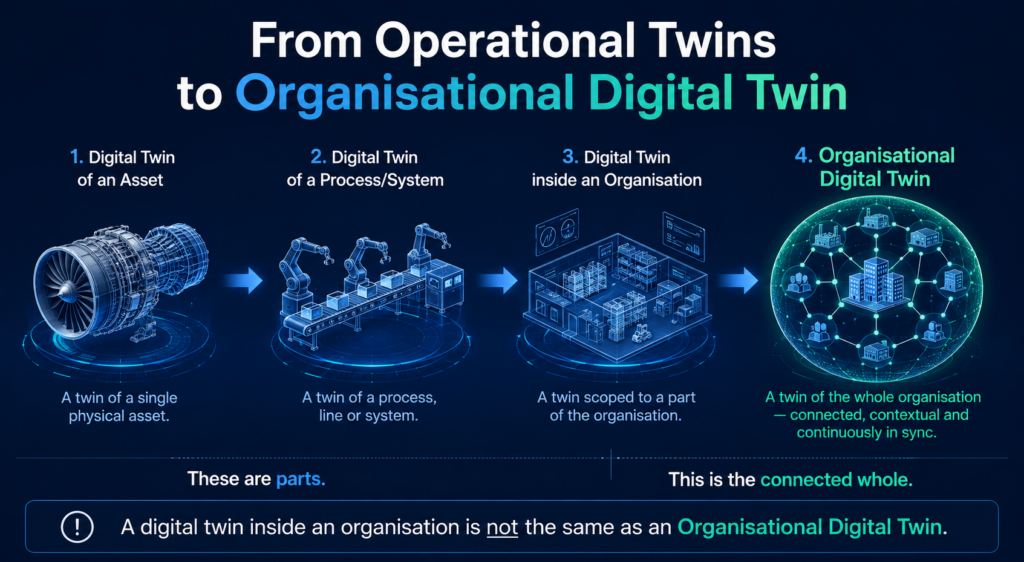
Rolls-Royce is a useful example. Its engine digital twins support testing, maintenance, efficiency and lifespan extension. The idea is easy to grasp because the object being twinned is clear. A physical engine exists in the real world, and a digital version helps reflect what is happening to it before problems become failures.
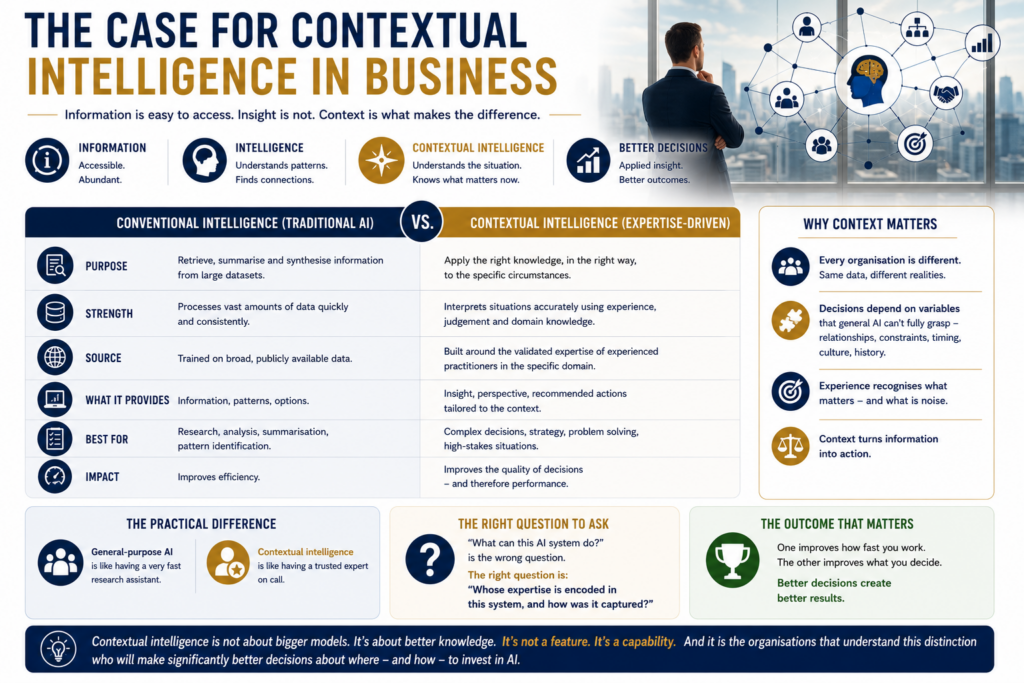
That is the simple power of a digital twin. It gives you a digital representation of something real, continuously updated by data, so you can see it more clearly and make better decisions about it. That is why digital twin thinking has moved into factories, fulfilment centres, supply chains, buildings, infrastructure and complex operational environments. The more physical, structured and instrumented the environment, the easier it is to twin.
Most digital twins today are still rooted in operational contexts. They help organisations understand assets, processes, systems and environments where activity can be measured and modelled with confidence. But an organisation is not just an operational system. It is also a human and strategic system.
So the move from a digital twin inside an organisation to an Organisational Digital Twin is not simply a bigger version of the same idea. It is a different level of ambition.
A company may have a digital twin of a production line, warehouse, supply chain, building, technology system or critical asset. These may be sophisticated and valuable, but they are still twins of parts of the organisation. They do not necessarily represent the organisation itself.
A digital twin inside an organisation is not the same as an Organisational Digital Twin.
The leadership problem
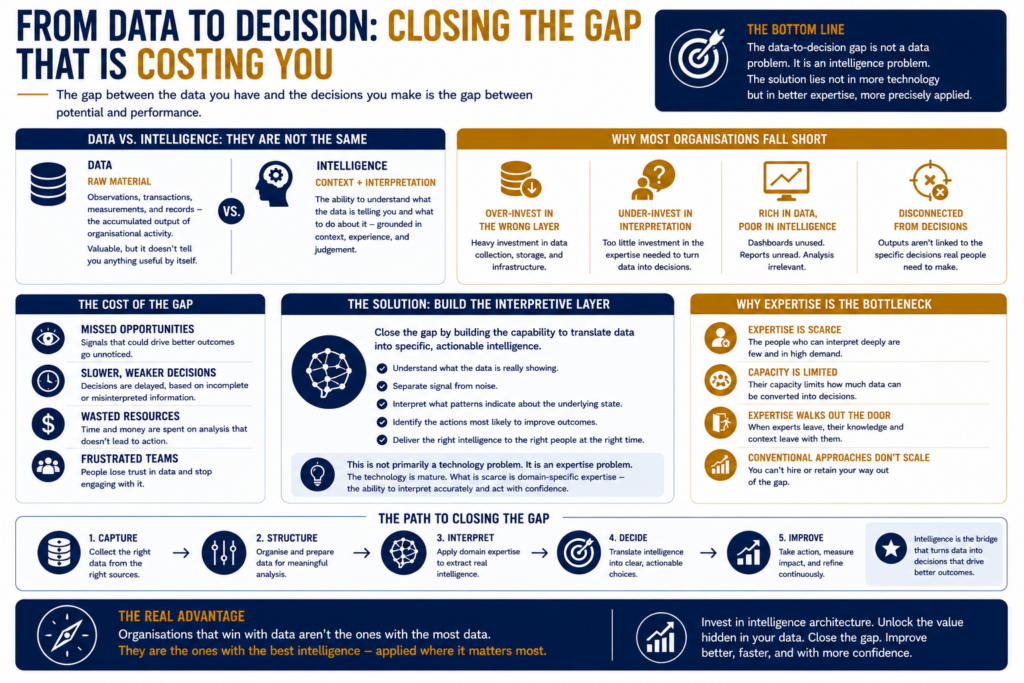
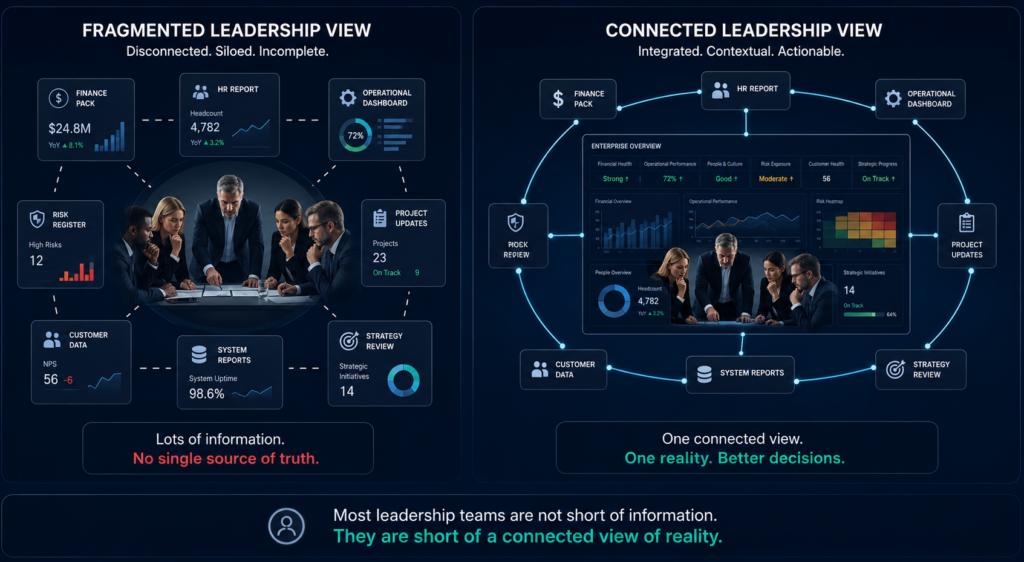
Most leadership teams do not lack information. They have finance packs, dashboards, HR reports, customer data, project updates, risk registers, system reports, strategy updates and board papers. The problem is not usually the absence of data; it is that the information is often disconnected, partial and lagging. Each function has its own view, rhythm, language and interpretation of what is going on.
But organisations do not perform in neat functional boxes. Performance happens through the interaction between people, process, systems and data. A delay in delivery may look like a process issue, but it may actually be caused by unclear ownership, weak handovers, uneven capability, system friction, competing priorities or a strategy that has not translated properly into day-to-day work.
A technology issue may not be purely technical either. It may be about adoption, process design, governance, training or leadership attention. Equally, what looks like a people issue may be the result of poor systems, unclear process, unrealistic priorities or a structure that makes effective working harder than it needs to be.
That is the leadership challenge. Leaders are often trying to run the organisation through fragmented views of reality. They can see symptoms and performance movement, but not always the organisational dynamics driving them.
The promise of an Organisational Digital Twin
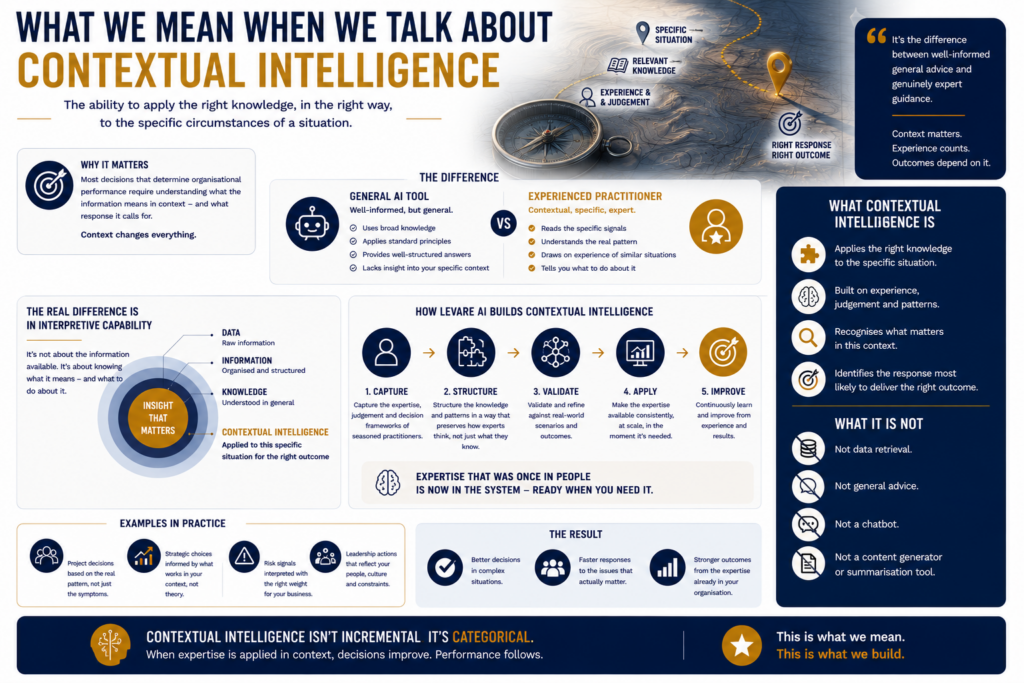
In principle, an Organisational Digital Twin gives the leadership team a more connected and current representation of how the organisation is actually operating. Not just what the organisation chart says, what the dashboard reports, what the process map describes, or what the latest board pack summarises, but a living representation of the organisation’s operating reality.
The word living matters. A true ODT cannot be a static snapshot. It needs to be updated through real-time or near-real-time signals, so leaders are not just looking at what the organisation looked like last month, but at how it is operating now.
Gartner describes a Digital Twin of an Organisation as a dynamic software model that uses operational and contextual data to understand how an organisation operationalises its business model, connects with its current state, responds to change, deploys resources, simulates future states and delivers customer value. That definition is useful because it shows the scale of the ambition. An Organisational Digital Twin is not simply a better dashboard or a more detailed process model. It is a dynamic view of how the organisation operates, responds and delivers value.
The value of an ODT is not simply that it creates a more impressive model. The value is that leaders gain a shared operating picture from which to make better-informed decisions. It should help them see where the organisation is under pressure, where delivery is slowing, where systems are creating friction, where teams or departments are misaligned, and where capability does not match ambition.
But organisation is a bigger claim
This is where the language needs care. It is one thing to twin a jet engine, a production line or an automated fulfilment grid. These things may be complex, but they are also relatively structured, observable and instrumented.
An organisation is different. It includes processes and systems, but it also includes people, roles, skills, teams, leadership, decision-making, priorities, alignment, ownership and strategy delivery. That does not mean everything human can, or should, be digitally modelled. It cannot. But it does mean that a true Organisational Digital Twin cannot be mostly process, heavily systems, and only a nod towards people.
That may be a useful operational model, process twin, systems twin, or enterprise architecture model with live data attached. But it is not yet a twin of the organisation.
People, Process, Systems – connected by Data
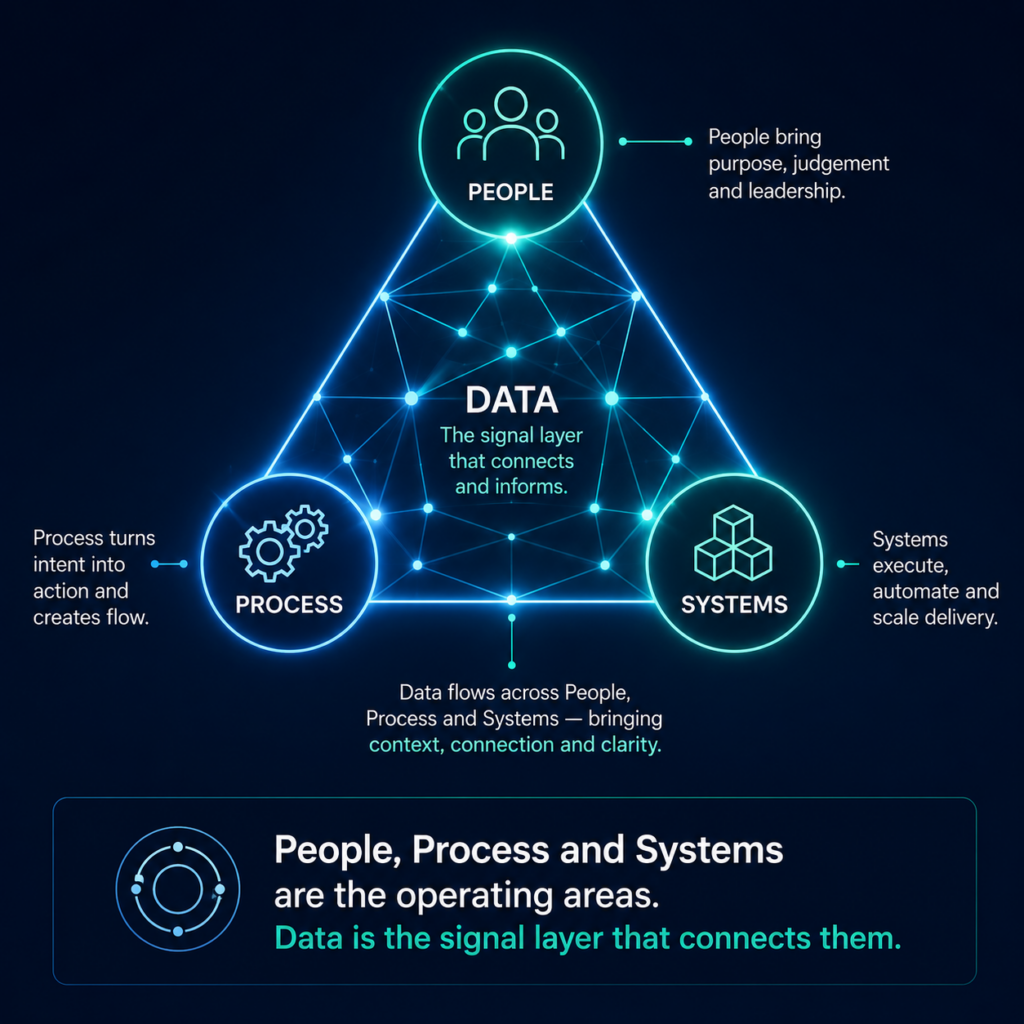
A simple way to test the maturity of the idea is to come back to how organisations operate. Most organisations operate through the interaction of People, Process and Systems. In the context of digital twins and AI, we also have to make Data explicit, because data is the signal layer that allows these areas to be seen, linked and updated.
The distinction matters. People, Process and Systems are operating areas. Data is different. It is the evidence and signal layer that allows those areas to be represented dynamically.
- People means the roles, capability, teams, leadership, ownership, alignment and understanding required to deliver the strategy.
- Process means how work flows, decisions move, priorities are coordinated and delivery happens.
- Systems means the technology, platforms, tools, assets, structures and operating mechanisms that enable the work.
- Data means the signals and evidence that allow the organisation’s reality to be seen, linked and updated.
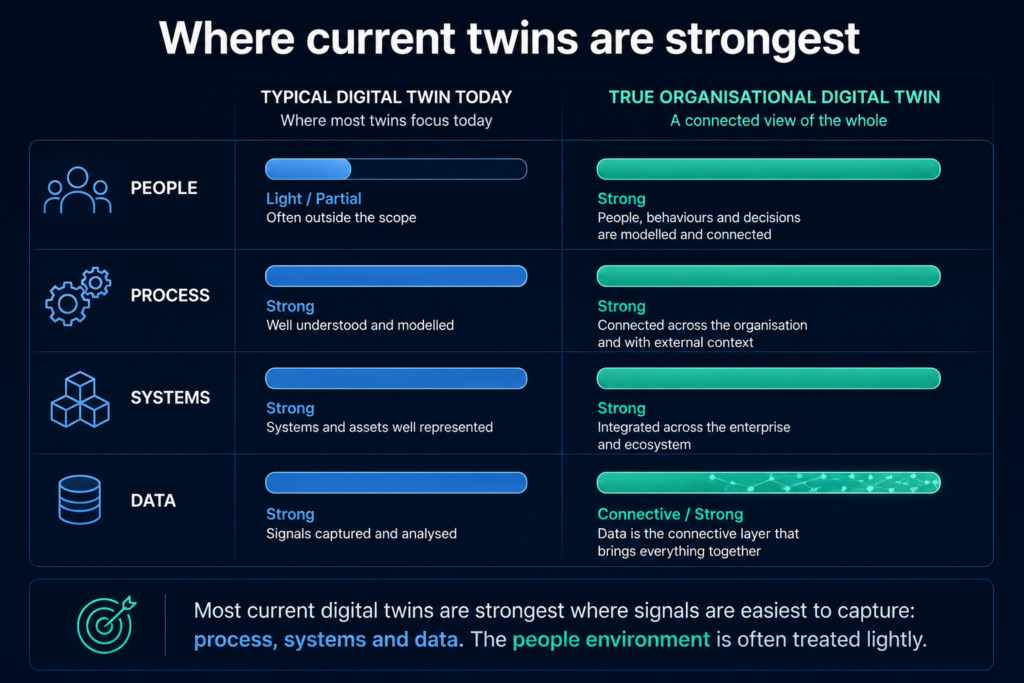
Current digital twin approaches are strongest where the signals are clearest: process, systems and the data those systems produce. That is why they work so well in structured operational environments, where they can represent flow, movement, asset condition, system behaviour, throughput and constraints.
But the people environment is often treated much more lightly. It may appear as workforce numbers, skills data, capacity planning, reporting lines, engagement scores or organisational charts. All of that can be useful, but it is not enough to understand whether the organisation has the right human operating environment needed to deliver the strategy.
The people environment is not about cloning people
The people environment of an Organisational Digital Twin is not about trying to model every individual’s motivation, personality, confidence, relationships or psychology. That would be impossible to do completely, and it would take the conversation in the wrong direction.
The more practical question is whether the organisation has the people environment required to deliver what it says it wants to deliver. That means understanding whether the right people are in the right roles, with the right skills, working in the right teams, clear on how their work connects to the wider strategy, able to work effectively with other teams, and operating in ways that support effectiveness and efficiency.
This is where many current digital twin conversations still feel incomplete. Traditional digital twin thinking has largely come from the process, systems and data side because those are the areas easiest to instrument, measure and model. That is understandable, but it leaves a gap.
Organisations do not deliver strategy through process and systems alone. They deliver through people using those processes and systems to achieve a strategic intent. Unless the people environment is represented properly, the twin may be useful, but it will still be partial.
The promise is bigger than the current reality
Imagine a leadership team with a living representation of the organisation across people, process and systems, connected by data. A representation that does not just show functional performance in separate reports, but helps reveal how the organisation is operating as a connected whole.
That would change the quality of leadership conversation. It would help leaders ask better questions about where the strategy is getting stuck, whether they are solving the right problem, and what the organisation is really capable of delivering.
That is the promise. The current reality is much narrower.
Most organisations have fragments: dashboards, reports, process maps, systems architecture, HR data, project plans, operational models and performance packs. Some have impressive digital twins of specific assets, processes or operational environments, but very few have anything that can credibly be described as a true Organisational Digital Twin.
The direction of travel should not be another dashboard, another reporting layer or another single-domain model. It is to build towards a connected organisational intelligence layer that helps leadership teams understand how the organisation is operating across people, process, systems and data as one connected whole.
That matters because most organisations still manage complexity through fragmented reporting structures and isolated functional views. The longer-term opportunity is to move beyond fragmented organisational visibility and build towards a clearer, more connected representation of organisational reality.
The real prize is not a more impressive model. It is a leadership team with a clearer, shared view of reality. For leadership teams, the value lies in seeing earlier, diagnosing better and acting with a fuller understanding of how the organisation really works.
A true Organisational Digital Twin should help leaders diagnose more accurately, act earlier, understand consequences more clearly, and make better decisions about how the organisation performs.
The opportunity is to move beyond digital twins of organisational parts and build towards a clearer, more connected view of how organisations really perform.
Until the people environment is represented alongside process and systems, connected by data, most Organisational Digital Twins will remain twins of parts of the organisation, not the organisation itself.
Be among the first to access Levare AI.
We are opening access in stages.
Join the waitlist and we will be in touch when your place is ready.