There is a conversation that happens in investment discussions that I find increasingly important and increasingly underexplored. It is the conversation about execution.
Most investment analysis focuses on market size, competitive positioning, team quality, and financial model. These are the right things to analyse. They are also, in most cases, insufficient – because the variable that most determines whether a fundamentally sound investment thesis delivers the returns it promises is not any of these factors. It is execution.
Execution is the difference between a business that has a compelling strategy and one that delivers on it. It is the difference between a leadership team that is theoretically capable and one that actually performs. And it is the difference between the financial projections in an investment deck and the numbers that appear in the accounts three years later.
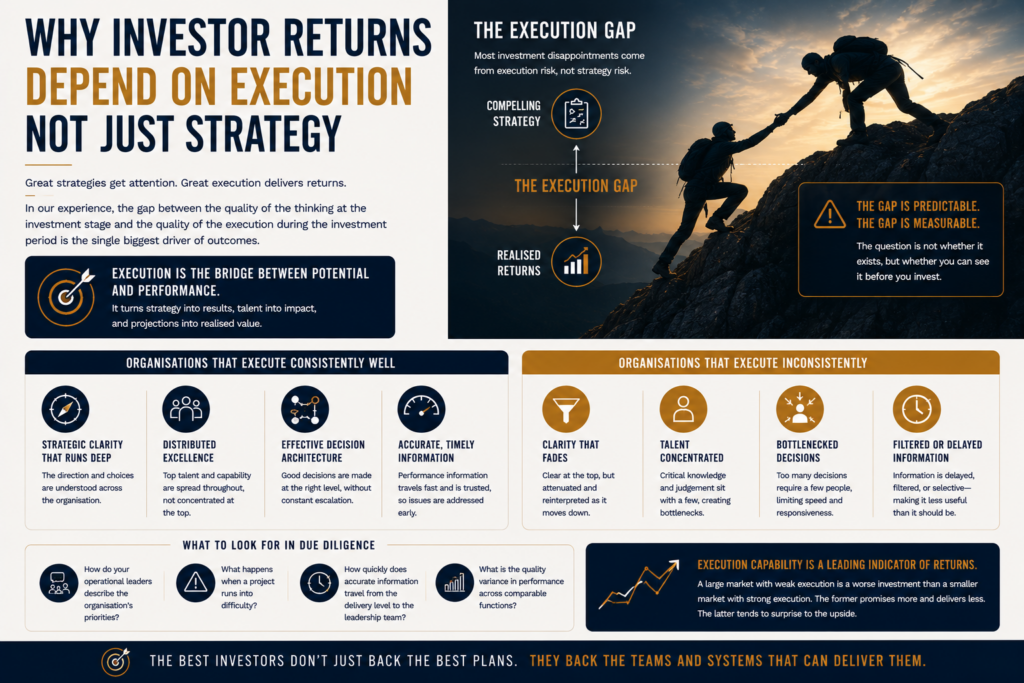
In my experience, the investment cases that disappoint are rarely those where the market analysis was wrong or where the team was insufficiently talented. They are the cases where the gap between the quality of the thinking at the investment stage and the quality of the execution during the investment period was larger than the analysis suggested it would be.
This gap is predictable. It is also, in most cases, measurable – if you know what to look for.
The organisations that execute consistently well share a set of characteristics that are observable before the execution begins. They have strategic clarity that runs below the leadership team. Their best people understand not just the direction but the specific choices that define it. Their decision-making frameworks are explicit enough that good calls are made without constant escalation. And their performance information is accurate enough – and travels fast enough – that problems are visible while they are still addressable.
The organisations that execute inconsistently have a different set of observable characteristics. Their strategic clarity is real at the top and attenuated as you move down the organisation. Their best people are concentrated rather than distributed. Their decision-making is bottlenecked around a small number of individuals whose capacity limits the organisation’s speed. And their performance information is filtered, delayed, or selectively presented in ways that make it systematically less useful than it should be.
These characteristics are not hidden. They are visible, to anyone who knows how to look for them, in the questions you ask and the answers you receive. How do your operational leaders describe the organisation’s priorities? What happens when a project runs into difficulty? How quickly does accurate information travel from the delivery level to the leadership team? What is the quality variance in performance across comparable functions?
The answers to these questions are more revealing than most due diligence processes acknowledge. They tell you not just whether the strategy is sound but whether the organisation has the capability to execute it – which is the variable that most determines whether the investment delivers.
My view, after twenty-five years of making and supporting investment decisions, is that the analysis of execution capability deserves at least as much weight in investment assessment as the analysis of market opportunity. A large market with weak execution is a worse investment than a smaller market with strong execution. The former promises more and delivers less. The latter tends to surprise to the upside.
The tools for analysing execution capability are less standardised than those for analysing markets or financial models. But they exist. And the investors who develop them consistently find that their ability to identify the investments that will actually deliver – rather than the investments that look best on paper – improves materially as a result.
Organisational intelligence starts with better understanding.
Interested in early platform access or receiving insights on leadership, performance and contextual intelligence – along with updates on the Levare platform.