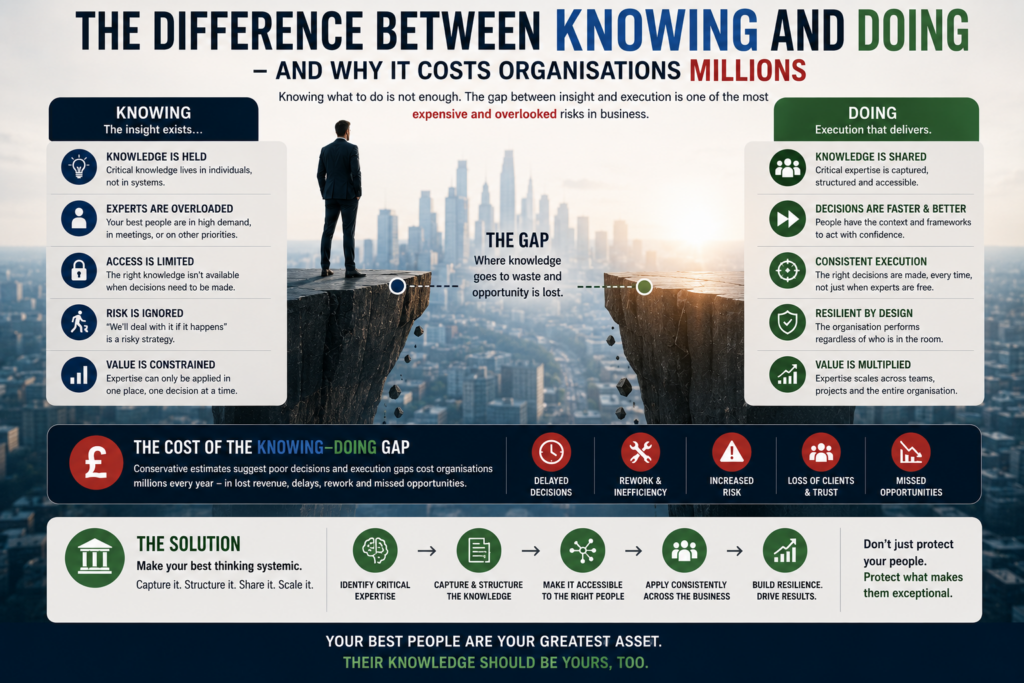
There is a concept in management consulting known as key-person dependency – the situation where a single individual, or a small group of individuals, holds knowledge, relationships, or capabilities so critical to the organisation that their departure would cause significant disruption.
Most organisations acknowledge this risk in theory. Far fewer take it seriously in practice.
The reason is understandable. Your best people are also your most engaged people. They are delivering results. They are part of the fabric of the organisation. The idea that they might leave tends to get filed under “things we will deal with if it happens” rather than “things we need to actively manage right now.”
This is a mistake. And it is a mistake that compounds over time.
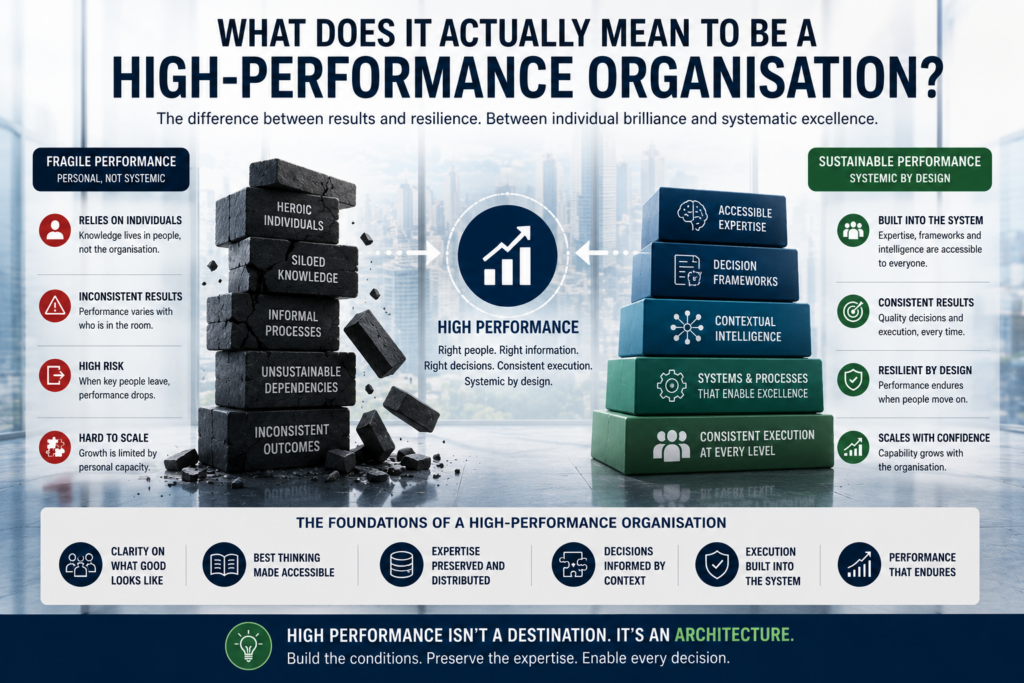
The problem with key-person dependency is not just the operational disruption caused by departure. It is the structural fragility it creates in the meantime. When critical knowledge lives in individuals rather than systems, the organisation’s decision-making quality becomes dependent on the availability, engagement, and accessibility of those individuals at the specific moment when decisions need to be made.
This rarely works as well as it appears. The experienced director who holds the institutional knowledge about a particular client relationship is also the person who is in three other meetings. The technical expert whose judgement is critical to a project decision is also the person managing six other workstreams. The leader whose contextual understanding of the market is irreplaceable is also the person who is, quite reasonably, planning to retire in three years.
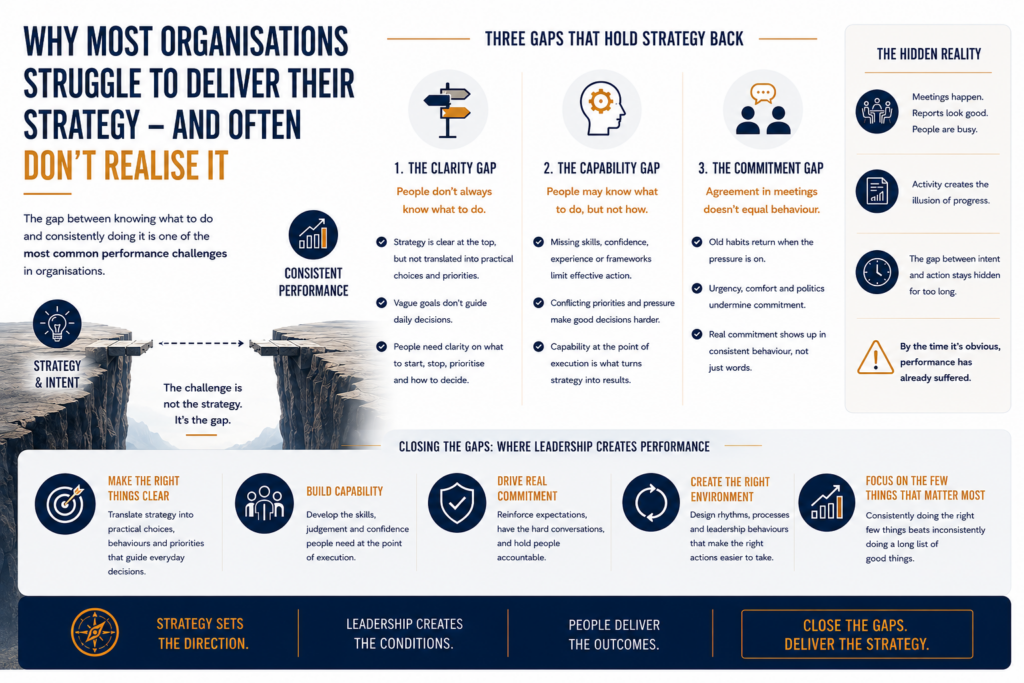
The gap between the knowledge that exists in an organisation and the knowledge that is accessible at the moment it is needed is one of the most consistently underestimated sources of execution failure.
There is a second dimension to this problem that is less commonly discussed. It is not just that your best people might leave. It is that even while they are present, their knowledge is not being used as effectively as it could be.
Expertise that lives inside an individual is, by definition, constrained by that individual’s capacity, availability, and attention. It can only be applied one conversation, one meeting, one decision at a time. It cannot scale. It cannot be in multiple places simultaneously. And it degrades over time as the individuals who hold it become overloaded, disengaged, or simply move on to other priorities.
The organisations that manage this risk most effectively are not the ones that try harder to retain their best people – although retention matters. They are the ones that treat the knowledge held by their best people as an organisational asset that needs to be actively captured, structured, and made accessible – before the people who hold it are no longer available.
This is a different kind of investment from the talent management strategies most organisations pursue. It is not about incentives or culture or development programmes, although all of those matter. It is about recognising that the competitive advantage of your most capable people is not just their presence – it is the knowledge and judgement they carry, and whether that knowledge survives them.
The question for every leadership team is not “how do we keep our best people?” It is “what happens to our capability if we don’t?”
If the answer to that question is uncomfortable, that discomfort is pointing at something important. Not a problem to be managed with a retention bonus, but a structural vulnerability that needs to be addressed at a deeper level.
Your best people are your greatest asset. They are also, if you are not careful, your greatest single point of failure.
Organisational intelligence starts with better understanding.
Interested in early platform access or receiving insights on leadership, performance and contextual intelligence – along with updates on the Levare platform.