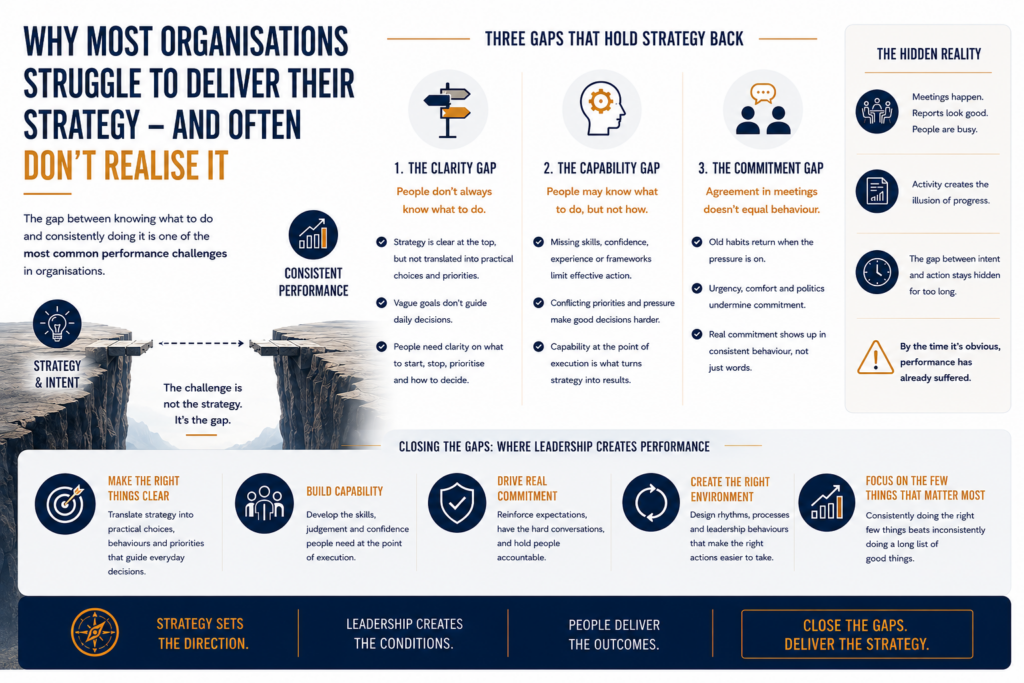
There is a question I find myself asking in almost every organisation I work with. It is not a complicated question, and on the surface it sounds like one every leadership team should be able to answer.
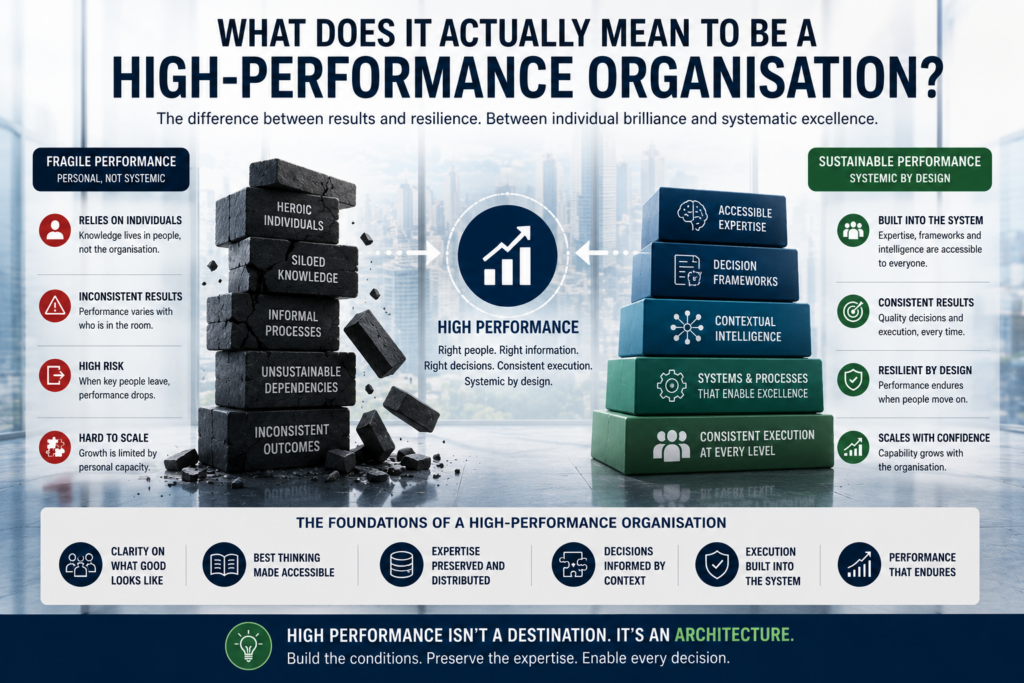
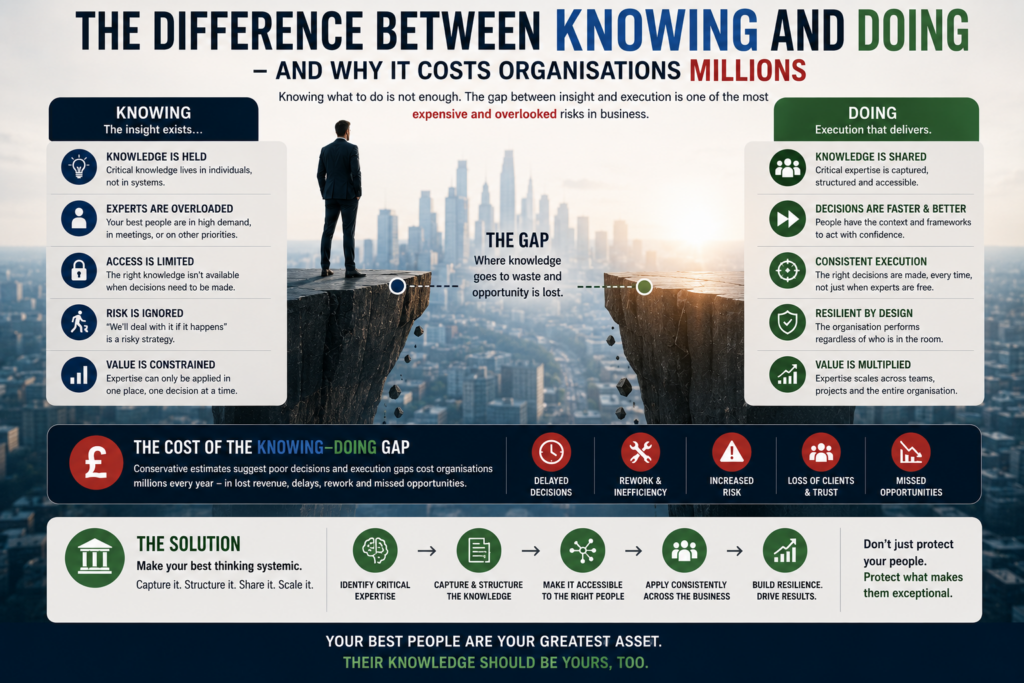
Does your organisation know what it needs to do to perform at its best – and is it consistently doing it?
Most leaders instinctively say yes. But when you press into the detail, the answer is often less certain. The strategy may be clear, the plan may make sense, and the leadership team may understand the priorities, but that does not mean the organisation is consistently doing the things that will make the strategy work.
That gap between knowing and doing is one of the most common performance challenges I see. It is not always a lack of talent, a poor strategy, a technology problem, a process problem, or a structural issue. More often, it is the gap between what an organisation says matters and what actually happens in the day-to-day reality of the business.
I first understood that gap in environments where the consequences were much more immediate. As a fast-jet pilot in the Royal Air Force, ambiguity had to be dealt with quickly. You needed clarity of intent, you needed to understand your role, and you needed the discipline to act under pressure. The gap between knowing what to do and actually doing it could not be allowed to drift.
The same was true in elite sport, although in a different way. A team can have a game plan, talented individuals, and a strong desire to win, but none of that matters unless it translates into behaviour under pressure.
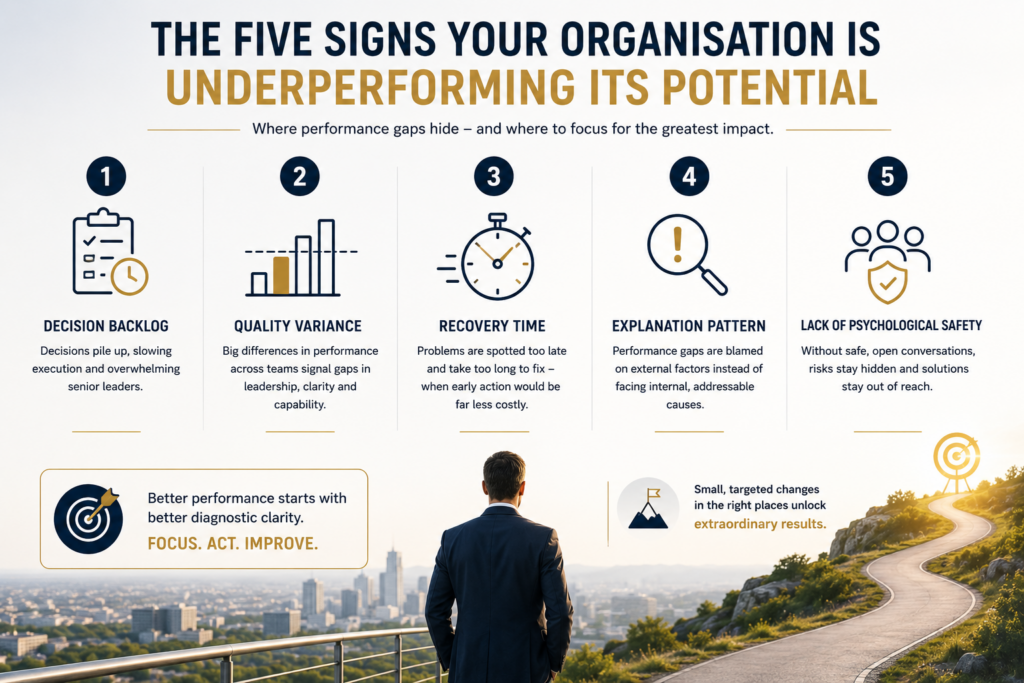
Business is different because the consequences are often slower to show themselves. The gap between intent and action can remain hidden for a long time. Performance can look acceptable. People are busy, projects are moving, meetings are happening, and reports appear to show progress. But underneath, the organisation may still not be doing the few things that really matter consistently enough.
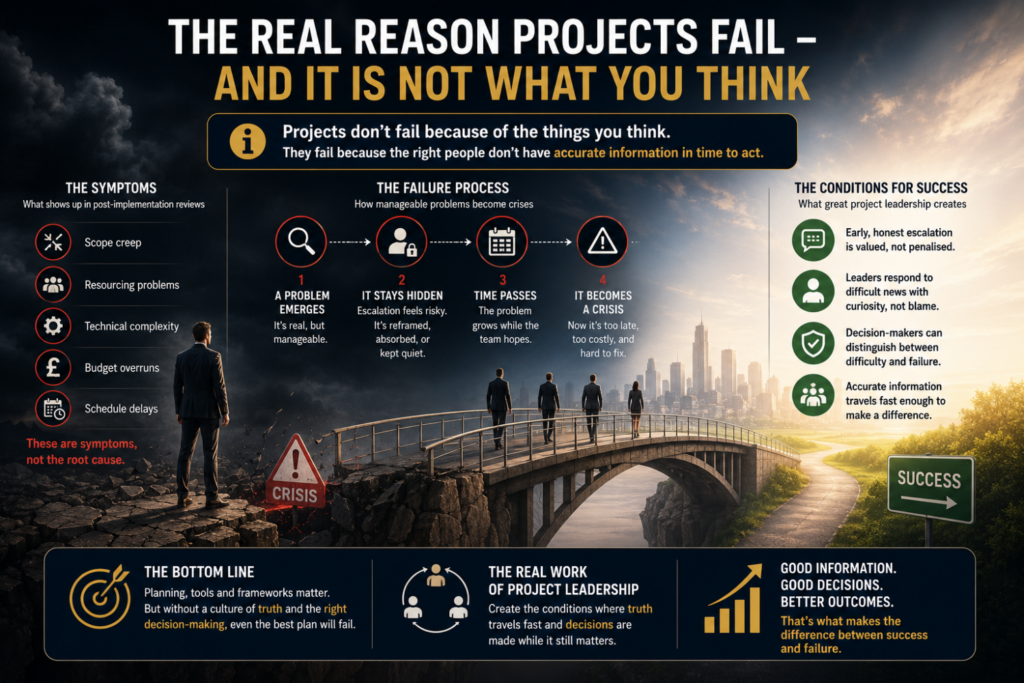
That is where leadership teams often misread the problem. They see missed targets, slow progress, inconsistent performance, frustrated teams, poor handovers, weak accountability, or projects that seem to lose momentum. So they respond to the symptoms. They restructure, introduce a new system, redesign a process, change reporting lines, or launch another initiative.
Sometimes those things are needed. But often they do not address the real issue, which is that the organisation has not created the conditions in which the strategy can be delivered consistently.
In my experience, that gap tends to show up in three ways.
The Clarity Gap
The first is a clarity gap. Strategy is almost always clearer to the people who created it than to the people expected to deliver it. A leadership team may know what they mean by “focus on existing clients”, “improve operational discipline”, “become more customer-led”, or “drive profitable growth”, but those phrases do not automatically tell people what to stop doing, what to start doing, what to prioritise, or how to make better decisions tomorrow morning.
This is one of the most underdone parts of organisational leadership.
The work is not simply to communicate the strategy. It is to translate it into the practical choices, behaviours, priorities, and rhythms that shape the way the organisation actually works.
The Capability Gap
The second is a capability gap. Even when people understand the direction, they may not have the knowledge, confidence, experience, or frameworks to act on it well. Organisations often assume that once the direction is clear, people will know how to deliver it. Sometimes they do. Often they do not.
A middle manager may understand the strategic direction but lack the confidence to challenge conflicting priorities coming from elsewhere in the organisation.
The issue is not that people are unwilling or incapable. It is that the specific capability needed to deliver the strategy may not exist at the level where the work actually happens. That might be commercial judgement, leadership confidence, cross-functional problem solving, prioritisation, effective challenge, decision-making, or simply the ability to hold a line when the pressure builds. Knowing what matters is not the same as knowing how to make it happen.
The Commitment Gap
The third is a commitment gap. This is the gap between agreement and behaviour, and most leadership teams will recognise it. People nod in the meeting, the logic is accepted, the direction seems clear, and everyone agrees that something needs to change. But once they are back in the reality of the business, old habits quickly reappear. The urgent work takes over, functional priorities become dominant again, difficult conversations are delayed, decisions get softened, and accountability becomes inconsistent.
That is not usually because people are being awkward or resistant. More often, it is because commitment is easy to express in a meeting and much harder to sustain when there is pressure, trade-off, or personal discomfort involved. Real commitment only shows up when people continue to behave differently after the conversation has moved on.
This is where many organisations get stuck. They assume that because people understand the strategy, they are aligned behind it. They assume that because people agree with the logic, they are committed to changing how they work. And they assume that because there is plenty of activity, meaningful progress is being made.
Closing those gaps is the real work of organisational leadership. It is slower than writing the strategy, less visible than launching a new initiative, and harder than changing a structure or buying a system. But it is where performance is actually created, because organisations do not deliver strategy simply because the strategy is good. They deliver it when the environment around their people makes the right things clear, practical, and consistently reinforced.
Strategy only creates value when the organisation around it is capable of turning intent into consistent performance.
Organisational intelligence starts with better understanding.
Interested in early platform access or receiving insights on leadership, performance and contextual intelligence – along with updates on the Levare platform.