Accountability is one of the most overused and least precisely defined concepts in organisational management. It appears in values statements. It features prominently in performance frameworks. Leaders call for more of it in response to almost every category of performance problem.
This, in itself, is strange because the definition of Accountability in many circles is (to paraphrase): “… the ‘person’ that ensures the work is performed.” Maybe an expanded definition should be “… the person that gets the credit when it works out well, and the person to blame if it goes wrong.”
And yet, in most organisations, the relationship between accountability and actual performance is considerably more ambiguous than the material suggests.
The problem is not that accountability is unimportant. It is that it tends to be deployed as a response rather than a foundation – introduced after performance has already deteriorated, applied to the symptoms of a problem rather than its causes, and associated in the minds of the people subject to it with consequence rather than support.
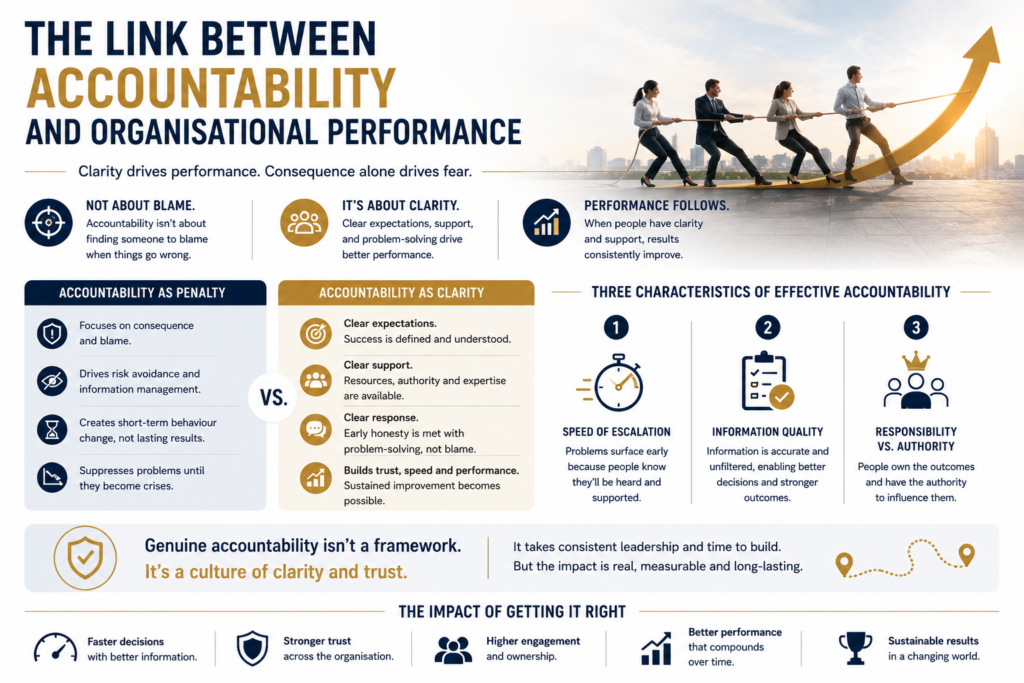
This version of accountability – accountability as penalty – is common, easily implemented, and largely ineffective at producing sustained performance improvement. It changes behaviour in the short term, typically in the direction of risk avoidance and information management rather than genuine performance enhancement. It creates the conditions for exactly the kind of information suppression that I described in my piece on why projects fail – the dynamic in which people manage the appearance of performance rather than addressing its reality.
The accountability that actually drives sustained performance improvement is different in a specific and important way. It is not primarily about consequences. It is about clarity.
Clarity about what is expected – not in general terms, but specifically enough that the people responsible for delivering it know, without ambiguity, what success looks like and how it will be assessed.
Clarity about what support is available – what resources, expertise, decision authority, and escalation pathways exist for the people responsible for delivering results.
And, Clarity about what will happen when things go wrong – not as a threat, but as a commitment: a genuine assurance that early, honest acknowledgment of difficulty will be met with problem-solving rather than blame.
The organisations where this kind of accountability is genuinely embedded tend to share a set of characteristics that are worth describing, because they are different from what most accountability frameworks produce.
Speed of Resolution Response
The first is speed of escalation. In organisations where accountability is genuinely about clarity rather than consequence, problems surface quickly. The people closest to the difficulty are the first to raise it, because they trust that raising it early will be more helpful than waiting. And the people they raise it to respond with the kind of engaged problem-solving that reinforces that trust.
Information Quality
The second is quality of information. In accountability cultures built on consequence, the information that travels upward tends to be shaped by the incentives around its presentation. Problems are minimised. Progress is emphasised. The picture at the top of the organisation is consistently more optimistic than the reality at the delivery level.
In clarity-based accountability cultures, the information that travels upward is more accurate – not because people are more honest in some abstract sense, but because the conditions that incentivise information management have been replaced by conditions that reward accuracy.
Responsibility vs Authority
The third characteristic is the relationship between authority and responsibility. In effective accountability cultures, the people responsible for delivering outcomes have genuine authority over the decisions that most determine those outcomes. Responsibility without authority is one of the most consistent sources of frustration, disengagement, and underperformance in organisational life – and it is surprisingly common in organisations that believe they have clear accountability.
Building genuine accountability is not a communication exercise or a framework implementation. It is a sustained cultural investment – one that requires consistent leadership behaviour over an extended period before it produces the conditions in which its benefits become visible.
But the investment is worth making. The difference between an organisation with genuine accountability and one with the appearance of it is measurable, significant, and compounding over time.
Organisational intelligence starts with better understanding.
Interested in early platform access or receiving insights on leadership, performance and contextual intelligence – along with updates on the Levare platform.