The professional services industry is at an inflection point that most firms are not yet taking seriously enough.
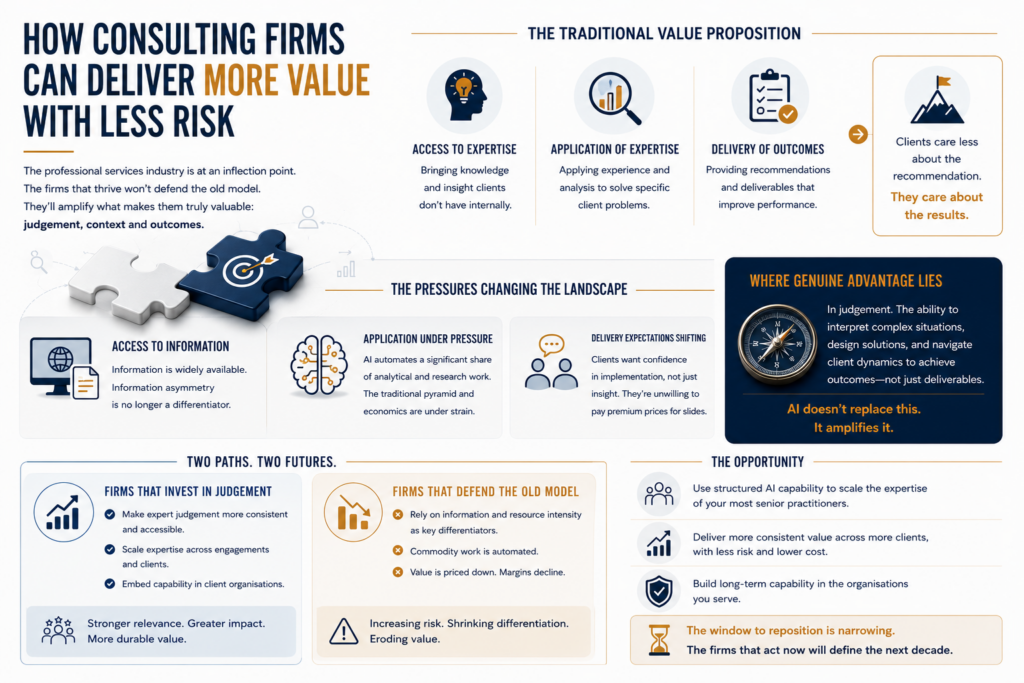
The value proposition of consulting, in its traditional form, is built on three foundations: access to expertise that clients do not have internally, the application of that expertise to specific client problems, and the delivery of recommendations or deliverables that improve client performance. This value proposition has been durable and commercially compelling for decades. It remains valid today.
What has changed – and what is changing more rapidly than most firms have acknowledged – is the degree to which each of these foundations is being pressured by developments in AI capability.
Access to information, which has always underpinned access to expertise, is now broadly available. The senior consultant who knew things that clients did not know because she had done the research, read the reports, and synthesised the analysis has a less distinctive advantage in a world where that research, those reports, and that synthesis are increasingly accessible to anyone with the right tools.
The application of expertise to client problems is more resilient – this is where genuine domain knowledge and contextual judgement matter – but it is being pressured from below by AI tools that can now perform a significant proportion of the analytical and research tasks that junior consultants have historically undertaken. The economics of the traditional consulting pyramid are under strain.
The delivery of recommendations and deliverables is also changing, as clients become increasingly aware of the distinction between receiving a recommendation and having the capability to implement it – and increasingly unwilling to pay premium rates for the former without confidence in the latter.
The firms that will navigate this inflection point most successfully are those that make a clear-eyed assessment of where their genuine competitive advantage lies – and invest in extending and deepening that advantage rather than defending the model that is being pressured.
Genuine competitive advantage in professional services has always resided in judgement – the ability to interpret a complex situation accurately, to design solutions that reflect deep domain expertise, and to navigate the specific dynamics of a client relationship in ways that produce outcomes rather than merely deliverables. This is not threatened by AI. It is, if anything, made more valuable by AI – because the commodity dimensions of consulting work that used to obscure the distinction between good judgement and adequate judgement are becoming easier to identify and price separately.
The question for consulting and advisory firms is whether they are positioned to compete on judgement – whether their real value proposition is the quality of their expertise and the depth of their contextual understanding, or whether it has relied, to a greater degree than is comfortable to acknowledge, on the information asymmetry and resource intensity that AI is now challenging.
The firms that are most honestly positioned on this question are finding that the emergence of structured AI capability is not a threat to their model but an opportunity – a way to make the judgement of their most experienced practitioners more consistently accessible across their engagements, more scalable across their client base, and more durably embedded in the organisations they serve.
The firms that are less honestly positioned on this question are finding that the same developments feel like an existential threat – because the commodity dimensions of their offering are being automated in ways that expose how much of their value was never really in the judgement.
The distinction between these two groups will define the professional services landscape of the next decade. And the window for firms to make the honest assessment and reposition accordingly is narrowing.
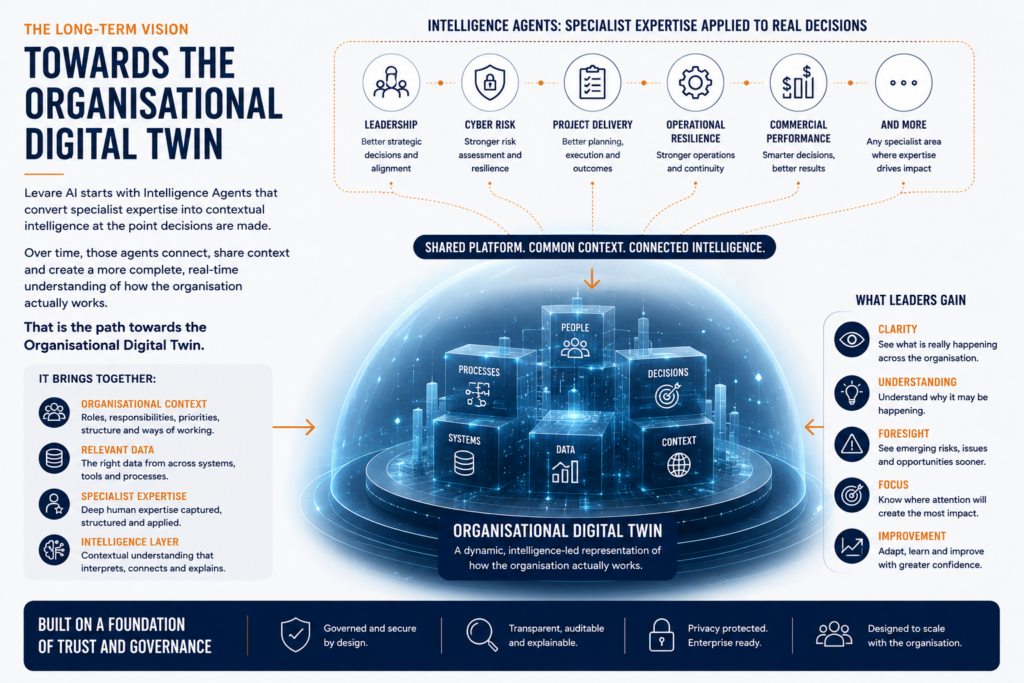
Organisational intelligence starts with better understanding.
Interested in early platform access or receiving insights on leadership, performance and contextual intelligence – along with updates on the Levare platform.