Every organisation generates data. Most organisations use a small fraction of it effectively. And the gap between the data that exists and the decisions that are made is one of the most consistent and consequential sources of underperformance in business today.
Understanding why this gap exists – and what it actually takes to close it – requires being honest about a distinction that is often elided in discussions about data and analytics.
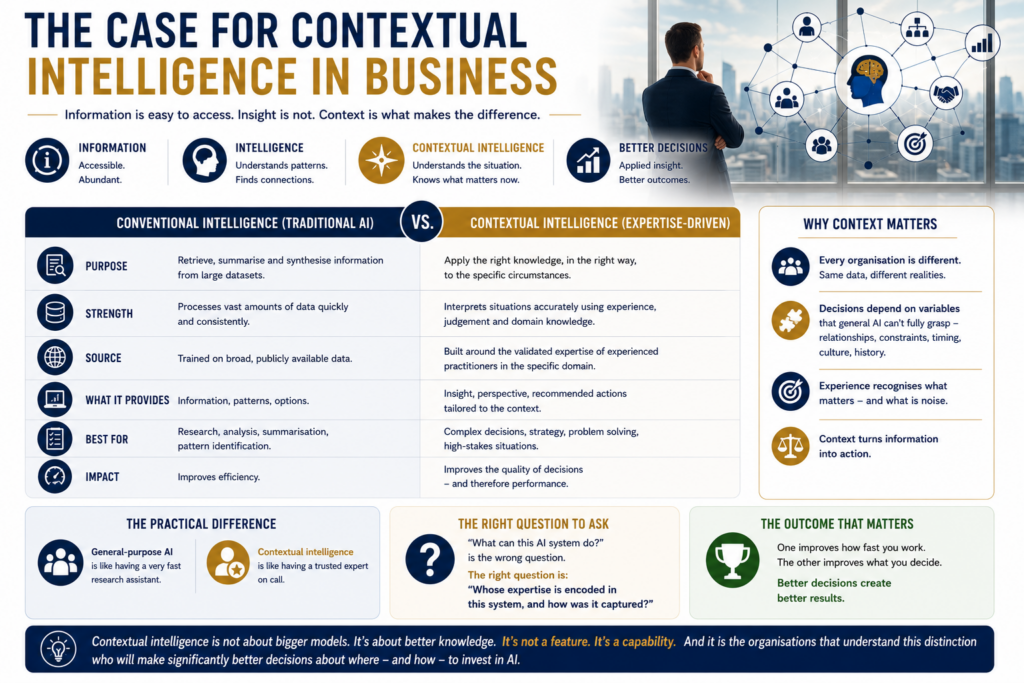
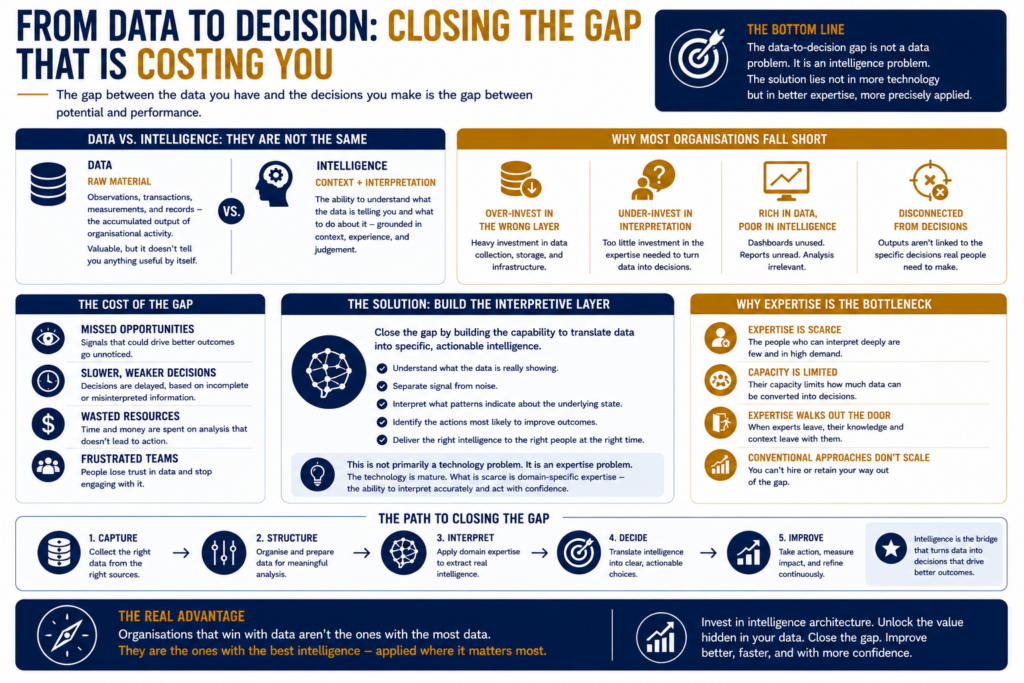
The distinction is between data and intelligence. They are not the same thing, and treating them as though they are is the root cause of most data strategy failures.
Data is raw material. It is observations, transactions, measurements, and records – the accumulated output of an organisation’s activities. In sufficient quantity and quality, it is genuinely valuable. But it does not, by itself, tell you anything useful. It has to be interpreted. And interpretation requires something that data alone cannot provide: the contextual understanding needed to know what the data is actually telling you and what to do about it.
This is where most data and analytics initiatives fall short. They invest heavily in data collection and data infrastructure – in the systems that generate and store observations – and significantly less in the interpretive capability needed to turn those observations into decisions.
The result is organisations that are rich in data and poor in intelligence. They have dashboards that nobody uses, reports that nobody reads, and analytical capabilities that produce outputs which are technically sophisticated but operationally irrelevant – because they are not connected to the specific decisions that need to be made by the specific people who need to make them.
Closing the gap between data and decision requires addressing the interpretive layer – the capability to take what the data is showing and translate it into specific, actionable intelligence for the people who need it.
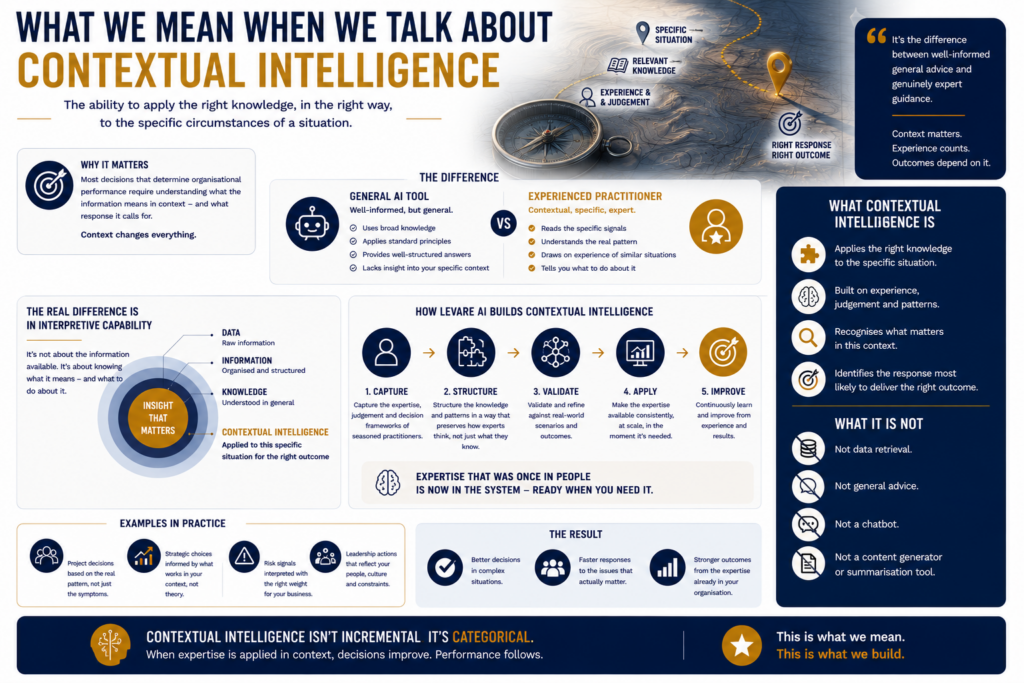
This is not primarily a technology problem. It is an expertise problem. The technology for collecting, storing, and processing data is mature and widely available. What is scarce is the domain-specific expertise needed to interpret the data accurately – to know which signals matter and which are noise, to understand what the patterns are indicating about the underlying state of the organisation, and to identify what specific actions are most likely to improve the outcomes that matter.
This expertise is hard to scale using conventional approaches. The analysts and advisors who hold it are finite in number and expensive to retain. Their capacity limits the rate at which an organisation can convert data into decisions. And when they leave, they take their interpretive capability with them.
The organisations that are closing this gap most effectively are the ones that have found ways to structure and scale the interpretive capability – to encode the expertise needed to translate data into intelligence and make it accessible to the people who need it, at the moment they need it.
This is a different kind of investment from the data infrastructure investments most organisations have been making. It is an investment in intelligence architecture – in the systems and frameworks that connect what the data is showing to what the organisation should do about it.
The data-to-decision gap is not a data problem. It is an intelligence problem. And like most intelligence problems, the solution lies not in more technology but in better expertise, more precisely applied.
Organisational intelligence starts with better understanding.
Interested in early platform access or receiving insights on leadership, performance and contextual intelligence – along with updates on the Levare platform.