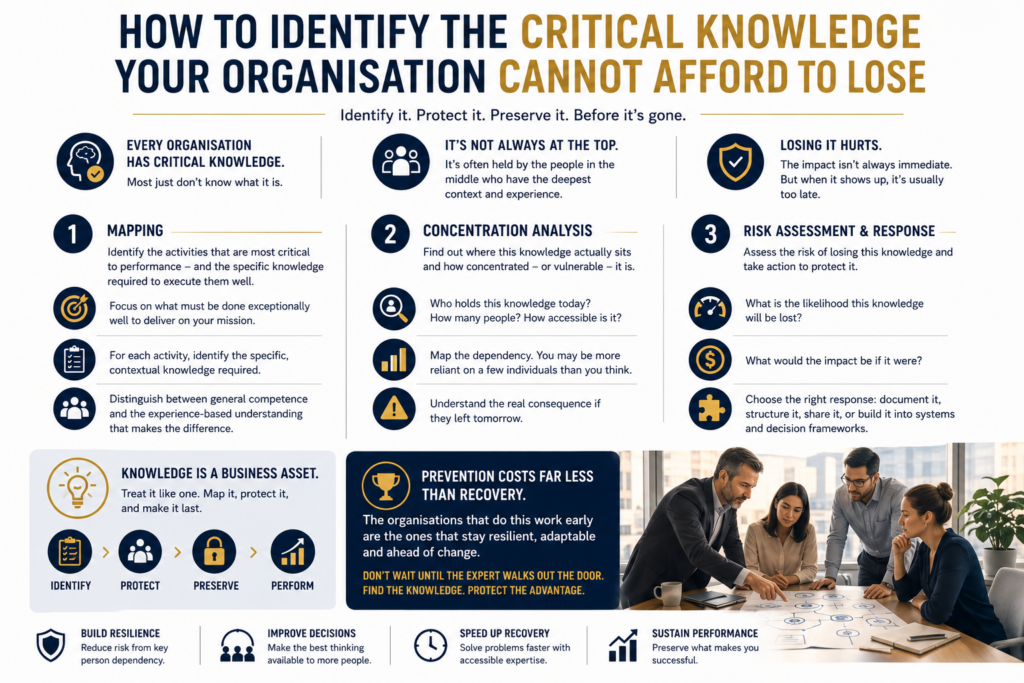
Every organisation has knowledge it cannot afford to lose. Most organisations have not identified what it is.
I mean something specific by this. Not the general sense that experience is valuable and expertise matters – that is well understood. I mean the precise, granular knowledge that, if lost, would have an almost immediate and material impact on the organisation’s ability to deliver its most critical activities.
This kind of knowledge is rarely held by the most senior people. It is not often associated with the highest-value roles. It is often found in the people who have been doing the same specific thing for a long time – who have accumulated, through years of practice, a depth of contextual understanding that is genuinely irreplaceable in the short term and genuinely difficult to replicate even over a longer horizon.
The process of identifying this knowledge – of mapping where critical understanding sits and what the realistic consequences of losing it would be – is one of the most valuable and least commonly undertaken exercises in organisational management.
I have led this process in organisations across multiple sectors, and the outputs are consistently surprising. Senior leaders expect the critical knowledge to be concentrated at the top of the hierarchy, in the strategic functions, in the most visible roles. In reality, it is often found in the middle layers – in the project managers who know how a specific client likes to be managed, in the technical specialists who understand the specific quirks of a legacy system that nobody else has worked with for long enough to know, in the supervisory operational leaders who have navigated the same regulatory environment for fifteen years and know exactly where the landmines are.
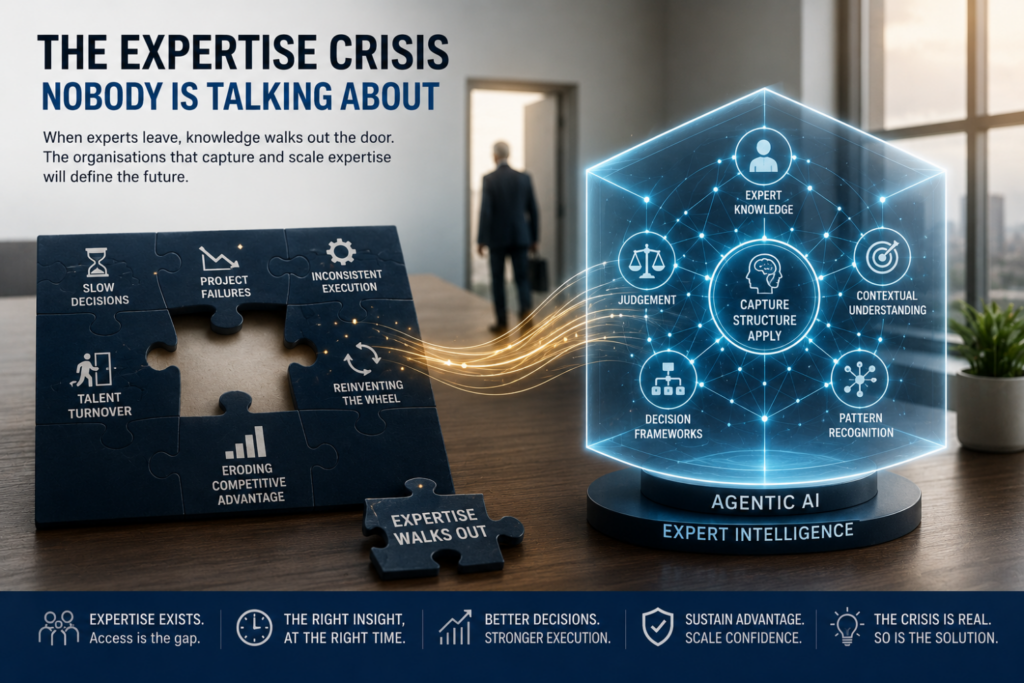
When these people leave, the knowledge they take with them is not immediately visible. It may not have an immediate impact. The organisation continues to function. The processes are in place. The documentation exists. And then a situation arises that the documentation does not cover, and the absence becomes apparent. The critical thinking that was relied on before, is no longer there.
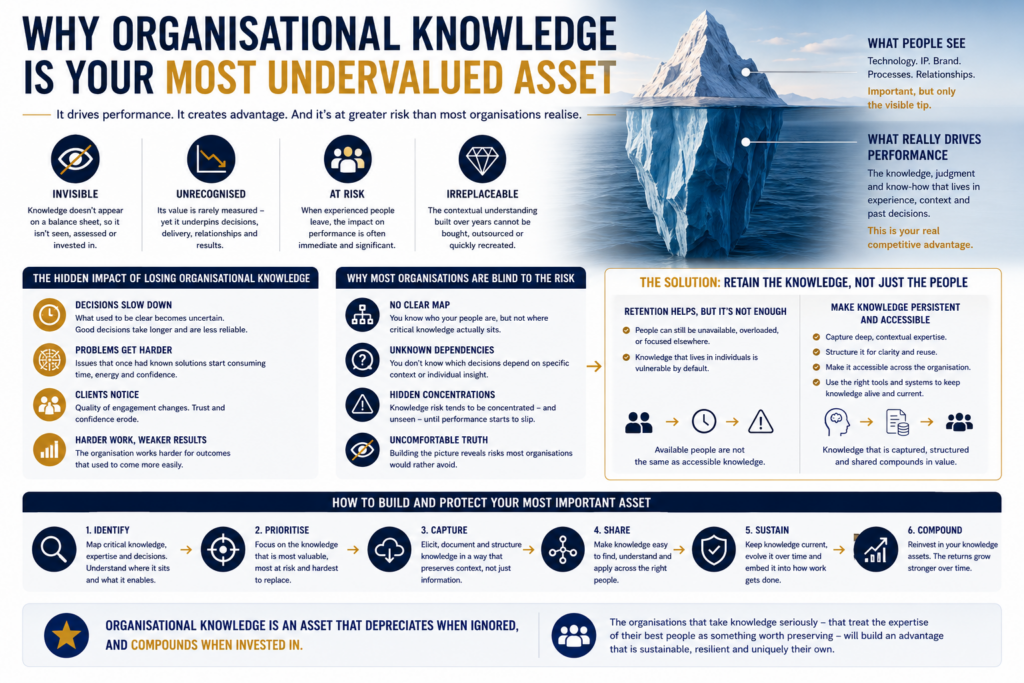
The process of identifying critical knowledge has three stages that are worth describing precisely, because each is necessary and none of them can be shortcut effectively.
Mapping
The first stage is mapping. A tedious exercise for many people, but critical. This involves systematically identifying the activities that are most critical to the organisation’s performance and asking, for each one, which specific knowledge is required to execute it well. Not general competency – anyone with relevant qualifications and experience has that – but the specific, contextual, experience-based understanding that distinguishes excellent execution from adequate execution in this organisation, with these clients, under these conditions.
Concentration
The second stage is concentration analysis. Once critical activities have been mapped, the question becomes: where does the knowledge required to execute them actually sit in the organisation? How many people hold it? How accessible is it to the people who need it? And what is the realistic consequence if the people who hold it are no longer available?
This stage tends to produce uncomfortable findings. Knowledge that leadership teams assumed was widely distributed often turns out to be held by a small number of individuals – sometimes by a single person. And the dependency on those individuals is often considerably higher than the organisation’s formal structures would suggest.
Assessment & Response
The third stage is risk assessment and response. Once concentration has been mapped, the question becomes: what is the realistic risk that this knowledge will be lost, and what would the impact be if it were? The response to this risk takes different forms depending on the nature of the knowledge, the likelihood of loss, and the organisation’s capacity to absorb disruption.
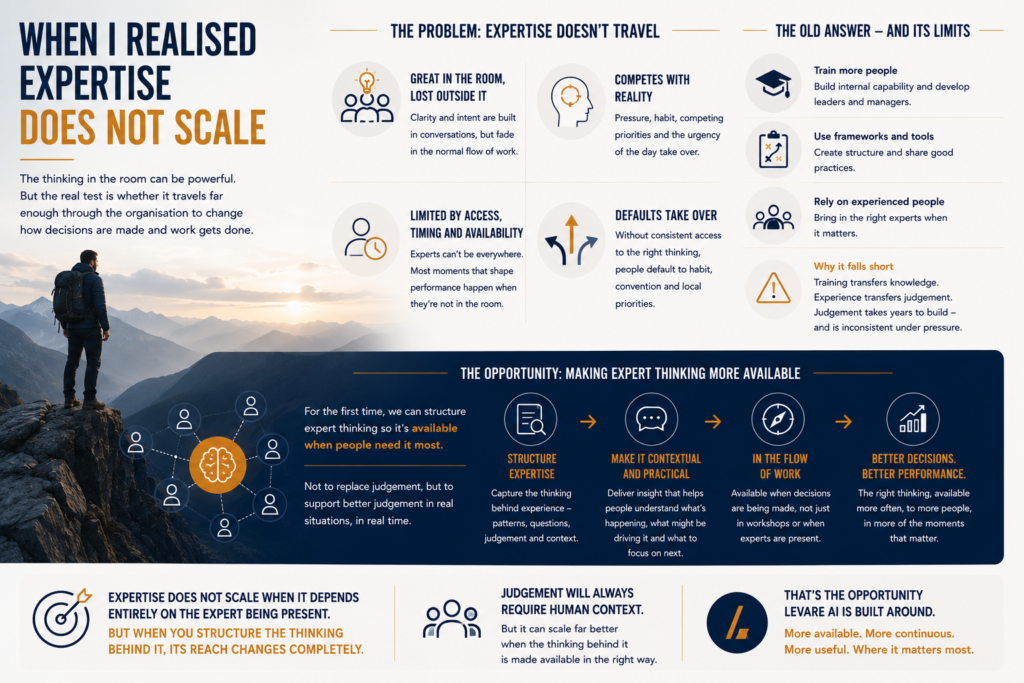
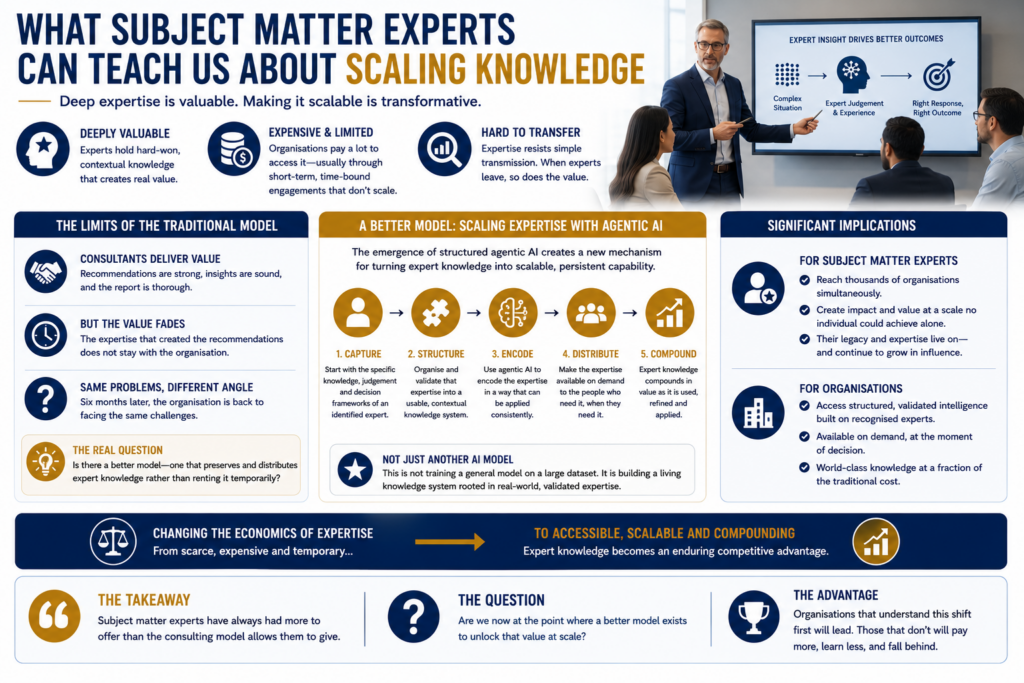
For some knowledge, the right response is documentation – creating records that make the knowledge accessible even when the individuals who hold it are not available. For other knowledge, particularly the deeply contextual and experiential kind, documentation is insufficient. The right response is structuring – finding mechanisms that preserve not just what the expert knows but how they think, so that the decision-making logic behind the knowledge is accessible as well as the knowledge itself.
The organisations that do this work before it becomes urgent are significantly better positioned than those that do it in response to a departure that has already happened. They are able to adapt, flex and maneuver in advance of systemic market changes and disruptions. The cost of prevention, in this domain, is substantially lower than the cost of recovery. As a prime example: ask a sales person how much it costs to reacquire a client after that client was lost to a competitor?
Organisational intelligence starts with better understanding.
Interested in early platform access or receiving insights on leadership, performance and contextual intelligence – along with updates on the Levare platform.