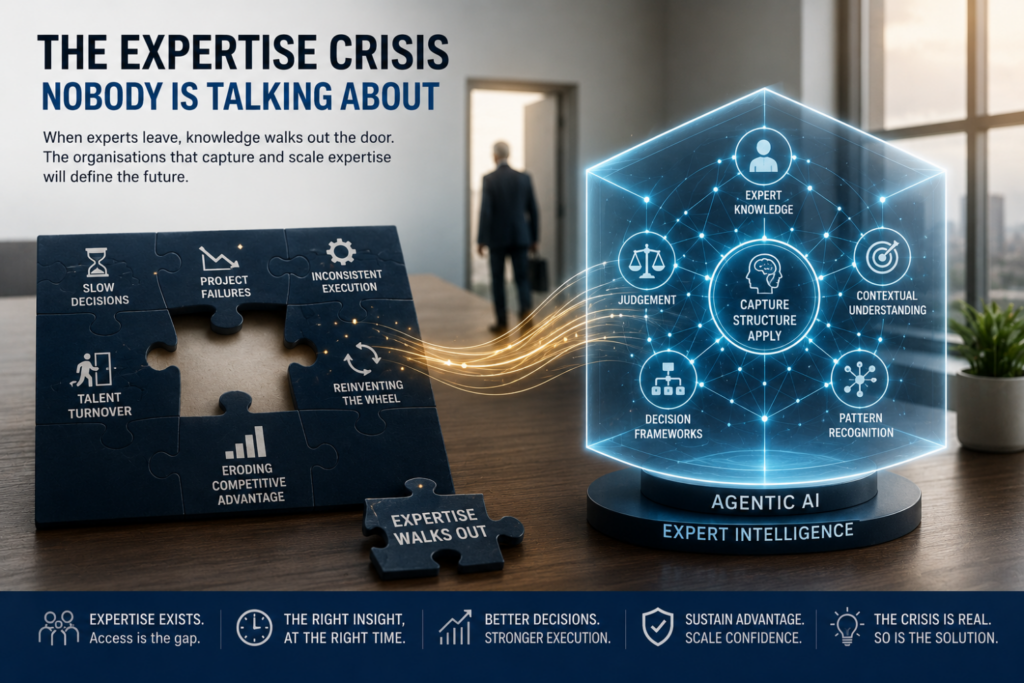
Every organisation has a knowledge problem. It just does not look like one.
It looks like an experienced director taking three months to make a decision that should take three days. It looks like a project failing because the person who knew how to run it retired two years ago. It looks like a new hire floundering in a role that a predecessor made look effortless – because the predecessor took everything they knew with them when they left.
This is the expertise crisis. And it is happening quietly, at scale, inside almost every organisation in the world.
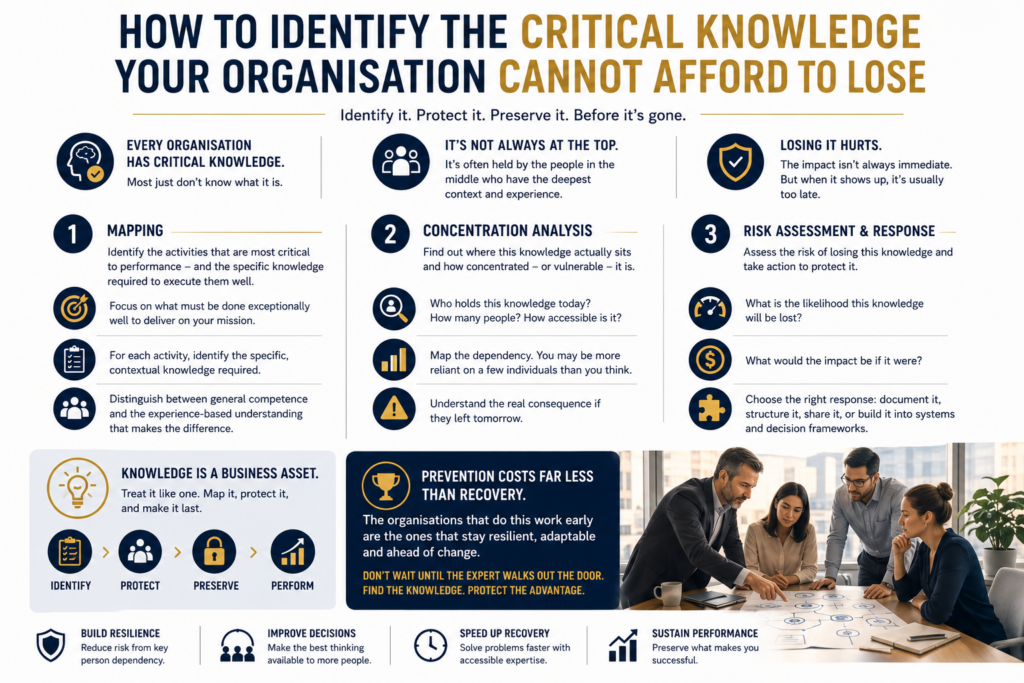
The scale of the problem is difficult to overstate. In the United Kingdom alone, hundreds of thousands of senior professionals retire or exit the workforce every year. Each one takes with them not just their job title and their experience, but their judgement – the accumulated pattern recognition, the hard-won contextual understanding, the ability to know not just what to do but when to act and how to apply the right response to the specific circumstances in front of them.
That knowledge is not in a manual. It is not in a database. It cannot be extracted by reading someone’s emails or reviewing their slide decks. It lives in the person. And when the person leaves, it is gone.
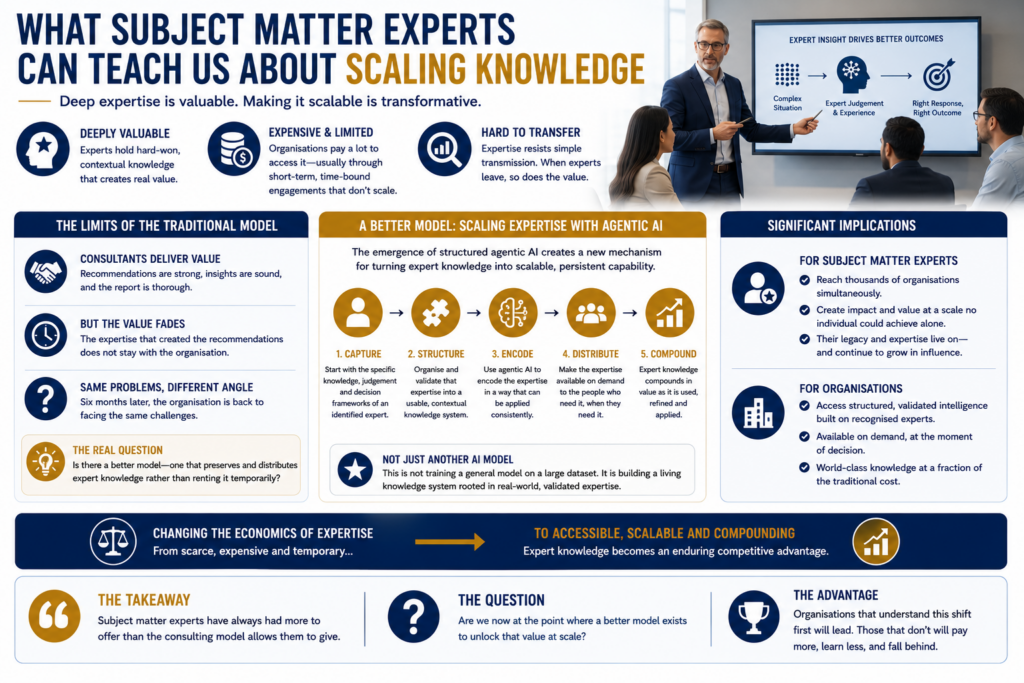
Organisations have tried to solve this problem in various ways, none of them particularly effective. Knowledge management systems collect documents nobody reads. Mentoring programmes pair senior people with junior people in the hope that osmosis will do what structure cannot. Exit interviews capture fragments of insight that are filed and forgotten. Consultants are brought in at considerable cost to replace, temporarily, the expertise that walked out of the door.
These are not solutions. They are workarounds. And they share a common flaw: they treat expertise as information, when in reality it is something far more complex.
The difference between information and expertise is the difference between knowing the rules of chess and knowing how to play it well. Information can be documented. Expertise – the ability to apply knowledge contextually, to read a situation accurately, to make the right call under pressure – is a different category of thing entirely.
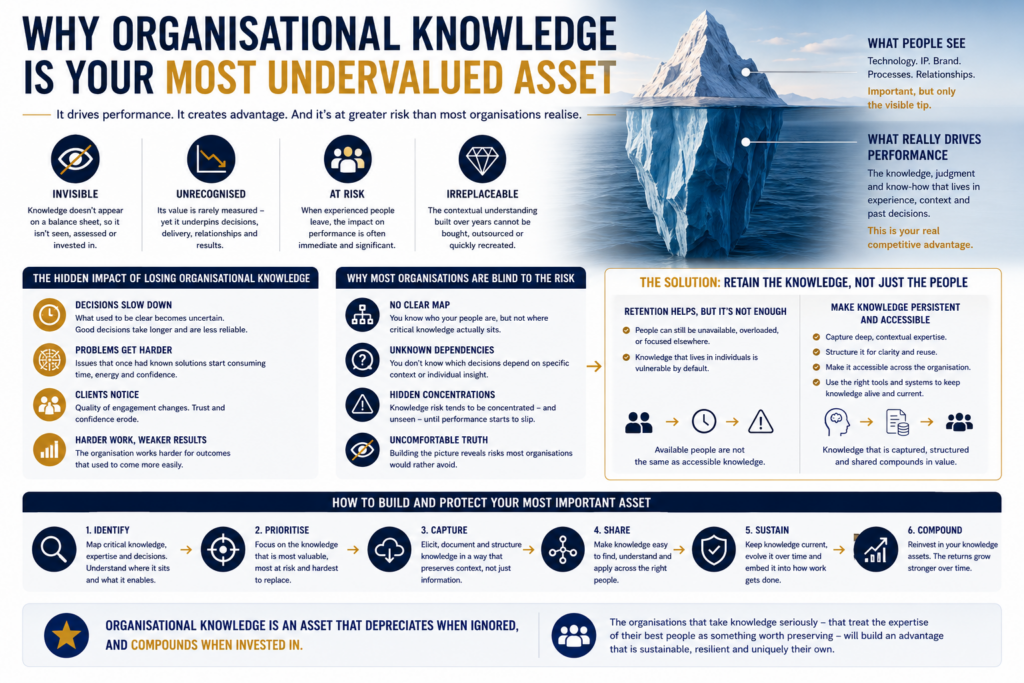
This is why most knowledge management initiatives fail. They capture what people know, not how they think. They preserve the output of expertise, not the process that generates it. And when a leader faces a genuinely difficult decision, a document that tells them what happened last time is not the same as having access to the person who navigated it.
The consequences for organisations are significant and growing. Execution quality becomes uneven and unpredictable. Decision-making slows as leaders without contextual grounding default to caution or to consensus. Competitive advantage that was built on the depth of specific expertise erodes as the people who held it move on.
The irony is that the expertise itself still exists. It has not disappeared from the world. It sits inside a generation of practitioners – in semi-retirement, in consultancy, in non-executive roles – who would be willing to share it if there were a practical mechanism for doing so.
That mechanism has not existed. Until now.
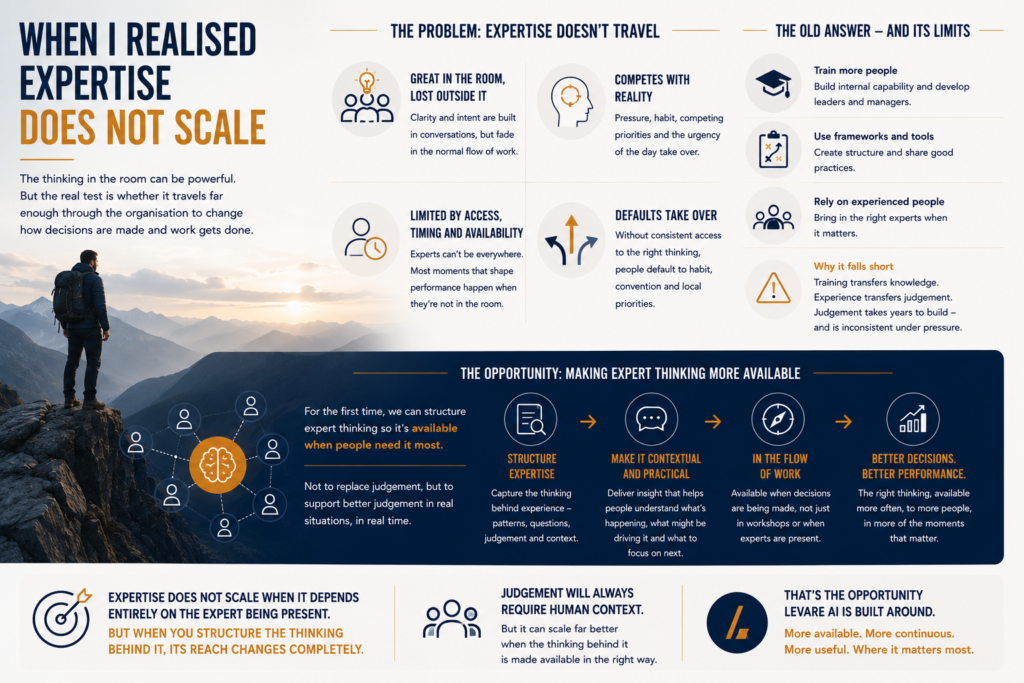
The emergence of structured agentic AI creates, for the first time, a genuine pathway from expert knowledge to scalable, on-demand intelligence. Not generic AI trained on internet data – but systems built specifically around the knowledge, judgement, and decision frameworks of identified experts in specific domains.
This is the shift that changes the equation. The expertise crisis is not a problem of supply. The knowledge is out there. It is a problem of access – and specifically, of the gap between the moment a decision needs to be made and the moment the right expertise can be applied to it.
Closing that gap is not a technology challenge. It is a structural one. And the organisations that solve it first will have a decisive and durable advantage over those that do not.
The expertise crisis is real. But for the first time, so is the solution.
Organisational intelligence starts with better understanding.
Interested in early platform access or receiving insights on leadership, performance and contextual intelligence – along with updates on the Levare platform.