

The Framework Behind Daedalus
The LIFT Model
The proven methodology that powers the Daedalus Intelligence Agent – developed across 200+ organisations over two decades of real-world application.
Every piece of intelligence Daedalus delivers is grounded in LIFT. Understanding the model helps you get more from the agent – and gives you a shared language for the conversations it will prompt inside your organisation.
THE FOUNDATION
Performance by design. Not by accident.
Most organisations perform well some of the time. LIFT is built for organisations that want to perform well consistently – not as a result of exceptional individuals or favourable circumstances, but because the conditions that produce high performance have been deliberately built and maintained.
LIFT is a practical framework developed through decades of real-world organisational experience, drawing on high-performance environments ranging from elite sport and flying fast jets to complex business strategy. It answers two questions that sit at the heart of what Daedalus is designed to help you address:
What are you doing to create an environment where high performance becomes inevitable?
How do you know your success is because of the way your teams work together – not in spite of it?
These questions, asked repeatedly across many organisations and sectors, revealed a consistent gap – not in people’s intent or talent, but in the environment surrounding them. LIFT is designed to close that gap systematically, by replacing the conditions that undermine performance with the conditions that produce it.
THE MODEL
Three Pillars. Twelve Dynamics. One coherent system.
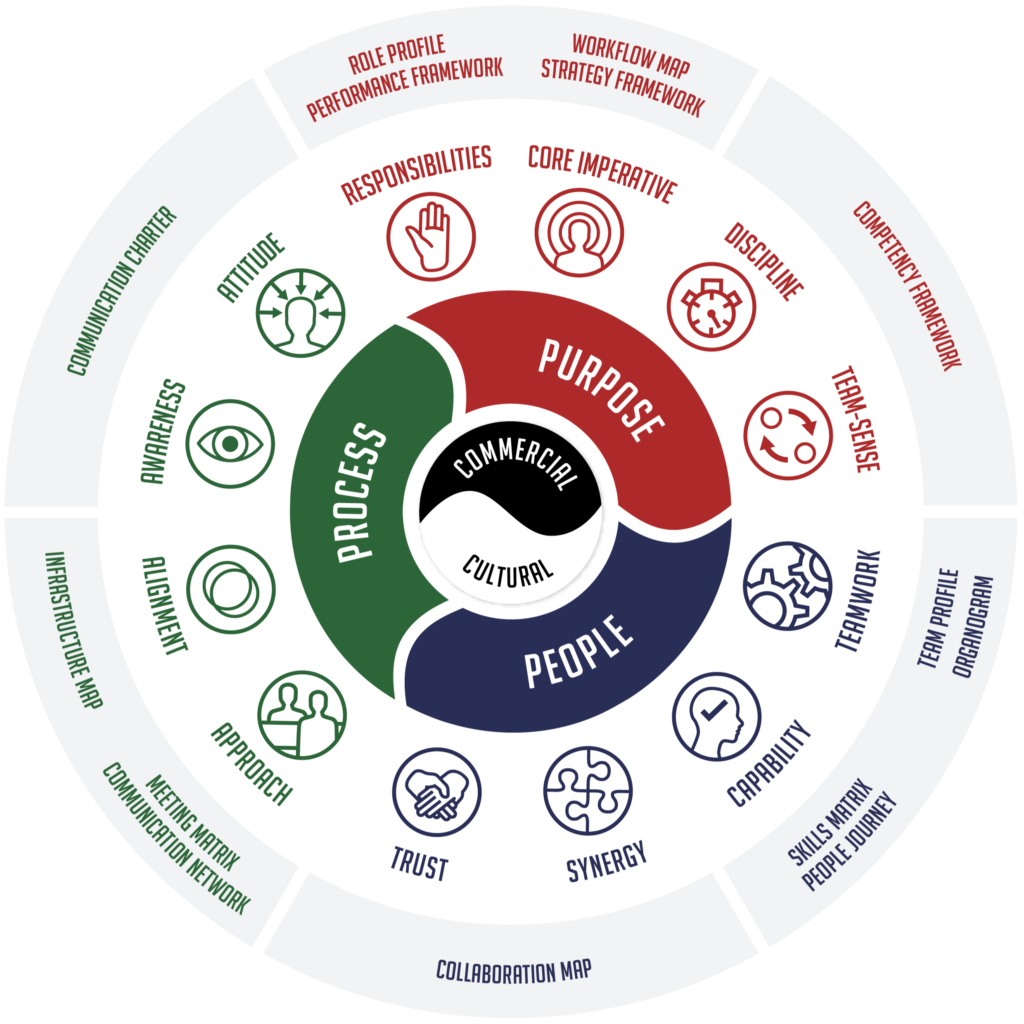
LIFT is organised into four interconnected layers:
- 3 Pillars – the foundational areas every organisation must get right: Purpose, People, and Process.
- 12 Dynamics – the conditions within each Pillar that drive performance. Each Pillar contains two Commercial Dynamics (focused on structures, systems, and roles) and two Cultural Dynamics (focused on behaviours, relationships, and mindset).
- 14 Elements – the practical tools that make each Dynamic real and actionable in day-to-day organisational life.
- 66 Solutions – the specific documents, templates, and outputs produced through each Element.
THE PILLARS
Purpose. People. Process.
The sequence matters. Purpose provides the direction. People provides the resource. Process ensures the organisation works efficiently and effectively enough to deliver. When all three are strong and aligned, performance becomes consistent rather than circumstantial.
Purpose
Does everyone understand what they are working towards – and how their contribution fits the bigger picture?
When the Purpose Pillar is strong, strategy moves from being a document to a day-to-day driver of decisions and behaviour. Roles are clear, priorities are shared, and the organisation operates with genuine focus and direction.
When it is weak, people feel directionless and unfocused — effort continues, but without coherence. Activity happens. Progress does not.
Daedalus connection: The strategic alignment intelligence Daedalus delivers is grounded directly in the Purpose Pillar – evaluating whether your organisation’s direction is genuinely embedded or merely communicated.
People
Does everyone have the right skills – and are they working together effectively to deliver on the strategy?
The People Pillar ensures individuals and teams are ready and able to perform – not just in isolation, but collectively. Capability is developed intentionally, teams are structured to collaborate, trust is built through consistent behaviour, and collaboration adds genuine value rather than just activity.
When this Pillar is underdeveloped, organisations experience disengagement and siloed working – capable people pulling in different directions without a shared framework for how they operate together.
Daedalus connection: When Daedalus surfaces people-related performance gaps, it is drawing on the People Pillar – identifying where capability, collaboration, or trust is limiting what the organisation can achieve.
Process
Is everyone working in the same way, to the same standard?
The Process Pillar gives the organisation the operational infrastructure to deliver at scale — clear communication, shared systems, aligned standards, and the openness to adapt when needed. When it is strong, the business operates with confidence and control.
When it is weak, ambiguity and inconsistency undermine even the best-intentioned efforts. People work hard but in different directions, using different approaches, to different standards.
Daedalus connection: Process-related intelligence from Daedalus identifies where operational inconsistency is creating friction — and where clearer systems and shared standards would have the greatest impact on performance.
THE CONDITIONS
What LIFT creates. And what its absence looks like.
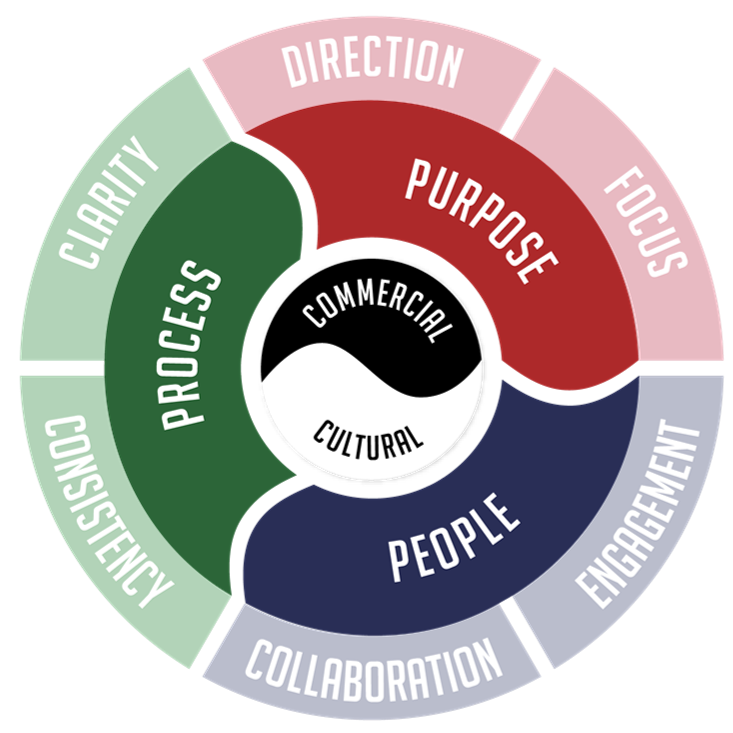
Underlying the model are six organisational conditions that LIFT helps create: Direction, Focus, Collaboration, Engagement, Consistency, and Clarity. These didn’t emerge from theory – they were surfaced through years of listening to organisations wrestle with the same frustrations. Their absence – being directionless, unfocused, disengaged, uncollaborative, inconsistent, or ambiguous – defines what a poor performance environment looks like. LIFT is designed to replace those conditions with their positive counterparts, systematically and by design, so that high performance becomes something an organisation builds and maintains – not something it occasionally stumbles upon.
in practice
How LIFT shapes what Daedalus tells you.
Every insight Daedalus delivers can be traced back to one or more of the three Pillars. When the agent identifies a strategic misalignment, it is drawing on the Purpose framework. When it surfaces a capability or collaboration gap, it is drawing on the People framework. When it identifies process inconsistency or decision-making friction, it is drawing on the Process framework.
This matters because it means the intelligence you receive is not generic. It is structured – grounded in a model that has been applied across 200+ organisations and refined continuously through real-world use. The recommendations Daedalus makes are not produced by a general AI trained on broad datasets. They reflect the specific expertise of practitioners who have used LIFT to diagnose and address the specific classes of problem your organisation is most likely to face.
Three practical implications:
The language is shared
LIFT gives you and your leadership team a consistent vocabulary for talking about performance – one that connects strategy to behaviour to outcome. When Daedalus uses terms like Purpose, People, or Process, it is not using them loosely. It is placing your organisation’s specific situation within a framework your whole team can use.
The diagnosis is structural
Daedalus does not just identify symptoms. It identifies which Pillar or Dynamic the symptom is rooted in – giving you a more precise understanding of what needs to change and where to focus. The difference between addressing a symptom and addressing its cause is the difference between temporary improvement and lasting change.
The insight compounds
The more you engage with Daedalus, the more the LIFT framework becomes embedded in how your organisation thinks about its own performance. Over time, the questions LIFT asks – about purpose, about people, about process – become part of how your leadership team operates, not just a tool they occasionally consult.
THE ORIGIN
Developed in the field. Not in a classroom.
LIFT was created by Rory Underwood MBE DL – former RAF fast-jet pilot, record-holding England international rugby player, and founder of Wingman Ltd. It emerged not from academic theory but from two decades of working with leadership teams across more than 200 organisations, asking the same questions that Daedalus now asks on behalf of every organisation that uses it.
The framework has been applied across sectors including professional services, financial services, technology, manufacturing, and retail – in organisations ranging from early-stage businesses to established enterprises. Its development has been iterative and evidence-based: refined continuously through real-world application rather than fixed at the point of creation.
Daedalus represents the next stage of that development – the point at which the LIFT methodology becomes accessible not through a consulting engagement, but through a structured Intelligence Agent available on demand to any organisation that needs it.
To find out more about Wingman Ltd and the consulting work behind LIFT, visit wingmanltd.com